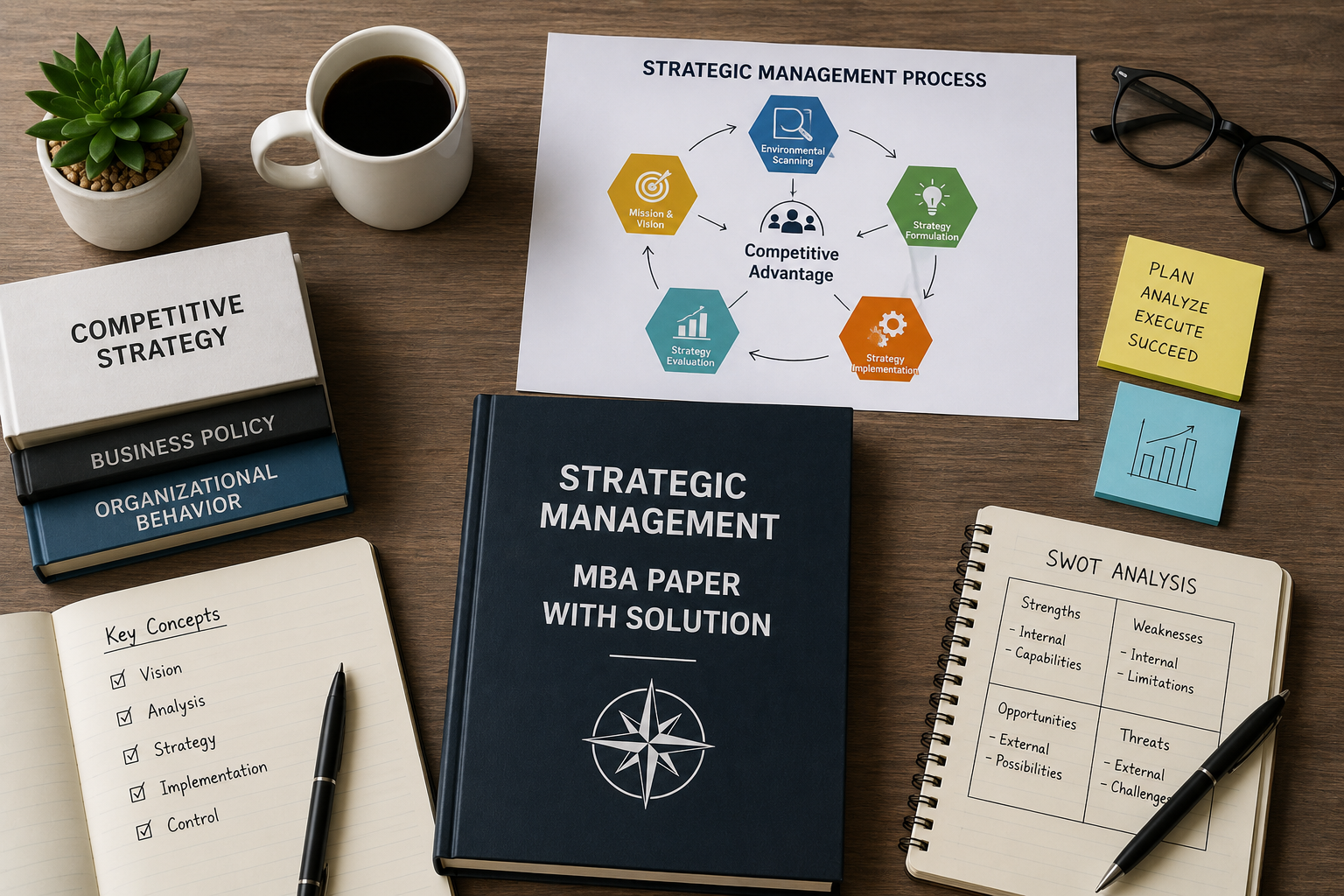
Strategic Management MBA Paper with Solution
Every company claims to have a strategy. Far fewer actually have one that survives contact with a competitor’s next move, a shifting market, or an unexpected crisis. Strategic management is the discipline that separates a genuine, adaptable plan from a slogan printed on the wall of a conference room.
This paper covers the core questions MBA students face on strategic management, answered the way you’d want to present them on an exam — structured, grounded in real examples, and written clearly enough to actually follow.
Strategic Management MBA Paper with Solution
Question 1: What Is Strategic Management?
Strategic management is the ongoing process of formulating, implementing, and evaluating decisions that allow an organization to achieve its long-term objectives. It involves analyzing the internal and external environment, setting direction, and continuously adjusting course as conditions change.
Strategic management typically covers:
- Environmental and competitive analysis
- Strategy formulation
- Strategy implementation
- Performance evaluation and control
Strategy isn’t a document that gets written once and filed away. It’s a continuous cycle. Markets shift, competitors react, and a strategy that worked well two years ago can quietly become outdated without anyone noticing until performance starts slipping.
Question 2: Explain the Levels of Strategy in an Organization
Strategy doesn’t operate at just one level. Most organizations manage strategy across three distinct layers.
Corporate-level strategy addresses which businesses or markets a company should compete in overall. This includes decisions about diversification, mergers, and acquisitions.
Business-level strategy focuses on how a specific business unit competes within its chosen market — whether through cost leadership, differentiation, or a focused niche approach.
Functional-level strategy covers how individual departments, like marketing or operations, support the broader business strategy through their day-to-day decisions.
A large conglomerate like Amazon operates strategy at all three levels simultaneously. Corporate strategy decides to expand into cloud computing and logistics. Business strategy shapes how AWS specifically competes against Microsoft Azure. Functional strategy governs how individual teams execute pricing, hiring, and operations within that unit.
Question 3: Discuss SWOT Analysis and Its Application
SWOT analysis is one of the most widely used strategic tools, examining a company’s Strengths, Weaknesses, Opportunities, and Threats.
Strengths are internal factors giving a company an advantage, like strong brand recognition or proprietary technology.
Weaknesses are internal limitations that put a company at a disadvantage, such as outdated systems or limited financial resources.
Opportunities are external factors a company could exploit, like an emerging market trend or a competitor’s misstep.
Threats are external factors that could harm the business, such as new regulation or an aggressive new competitor entering the market.
SWOT analysis works best as a starting point for deeper discussion, not a final answer on its own. Simply listing four categories doesn’t create strategy — the real value comes from asking how strengths can be leveraged against specific opportunities, or how weaknesses might be shielded from looming threats.
Question 4: Explain Porter’s Five Forces Model
Michael Porter’s Five Forces framework helps businesses analyze the competitive intensity and attractiveness of an industry. Harvard Business School’s original research on the Five Forces offers the definitive academic treatment if you want to explore it further.
The five forces include:
- Threat of new entrants — how easily new competitors can enter the market
- Bargaining power of suppliers — how much control suppliers have over pricing and terms
- Bargaining power of buyers — how much leverage customers have to demand lower prices or better terms
- Threat of substitutes — the risk that customers switch to alternative products or solutions
- Competitive rivalry — the intensity of competition among existing players in the industry
An industry with low barriers to entry, powerful suppliers, and many substitute options is generally far less attractive than one with the opposite conditions. Airlines are a classic example of a tough industry under this model — intense rivalry, powerful supplier leverage from aircraft manufacturers, and thin margins as a result.
Question 5: What Is the Difference Between Cost Leadership and Differentiation Strategy?
Porter’s generic strategies framework identifies two broad approaches businesses use to gain a competitive advantage.
Cost leadership involves becoming the lowest-cost producer in an industry, allowing a company to compete on price while maintaining acceptable margins. Walmart is a well-known example, built around operational efficiency and massive purchasing scale.
Differentiation involves offering something genuinely unique that customers value enough to pay a premium for, whether that’s superior quality, design, or brand experience. Apple is a frequently cited example, competing on design and ecosystem experience rather than price.
Trying to pursue both strategies at once, without a clear focus, often leaves a company “stuck in the middle” — unable to compete effectively on price against low-cost rivals, while also failing to justify a premium against genuinely differentiated competitors.
Question 6: Discuss the Concept of Strategy Implementation
Formulating a brilliant strategy means little if an organization can’t actually execute it. Implementation is often where strategy genuinely succeeds or fails.
Key elements of successful implementation include:
- Organizational structure aligned with strategic priorities
- Resource allocation directed toward the initiatives that matter most
- Leadership and culture that genuinely support the intended direction
- Clear communication ensuring employees understand their role in executing the strategy
A common failure point: leadership approves a bold new strategic direction, but resource allocation and incentive structures quietly remain unchanged, leaving employees pulled between old priorities and new stated goals.
Question 7: What Is Strategic Control, and Why Does It Matter?
Strategic control involves monitoring the execution of strategy and making adjustments as needed, based on actual performance and changing conditions.
The process typically includes:
- Setting performance standards tied to strategic objectives
- Measuring actual performance against those standards
- Analyzing variances to understand why gaps exist
- Taking corrective action, whether that means adjusting execution or revisiting the strategy itself
Without strategic control, companies risk continuing down a flawed path simply because nobody built in a mechanism to notice and correct course. This connects closely to the performance evaluation methods covered in our Human Resource Management MBA paper, since strategic control at the organizational level depends on the same disciplined measurement principles applied to individual performance management.
Question 8: What Is the BCG Growth-Share Matrix?
The Boston Consulting Group Matrix helps companies with multiple business units or product lines decide where to allocate resources, based on market growth rate and relative market share.
The matrix identifies four categories:
- Stars — high growth, high market share. These require significant investment but offer strong future potential.
- Cash Cows — low growth, high market share. These generate steady, reliable profit with less need for ongoing investment.
- Question Marks — high growth, low market share. These require careful decisions about whether to invest heavily or divest.
- Dogs — low growth, low market share. These often get divested or discontinued, since they typically drain resources without a strong return.
A diversified company might use profits from its Cash Cows to fund investment in promising Question Marks, hoping to turn them into future Stars. This kind of portfolio thinking helps leadership make more disciplined resource allocation decisions, rather than spreading investment evenly across every business unit regardless of its actual potential.
Why Strategic Management Matters in MBA Programs
Strategic management pulls together nearly every other MBA subject into a single, integrated discipline focused on long-term organizational success.
Studying strategic management helps students:
- Build frameworks for analyzing competitive environments
- Learn to connect high-level strategy with day-to-day execution
- Understand how to evaluate tradeoffs between different strategic options
- Prepare for leadership roles requiring big-picture thinking
- Appreciate why even well-designed strategies can fail without proper implementation
A Practical Example: Strategy in Action
Consider a mid-sized regional retailer facing growing pressure from e-commerce competitors. A SWOT analysis reveals a clear strength: loyal, long-term customers who value in-person service. It also reveals a real weakness: no meaningful online presence.
Rather than trying to compete head-on with e-commerce giants on price and shipping speed, leadership chooses a differentiation strategy instead. They invest in a hybrid model, combining a modest but well-designed online store with continued emphasis on personalized, in-store experience and same-day local delivery.
Implementation matters just as much here as the strategy itself. Store staff receive training on the new online system, and incentive structures are adjusted to reward employees for driving both online and in-store engagement, rather than treating the two as separate, competing channels.
Eighteen months later, online sales account for a modest but growing share of revenue, while in-store customer retention remains strong. The strategy didn’t try to beat competitors at their own game. It built on an existing strength while addressing a genuine weakness, and implementation ensured the plan didn’t just live on paper.
Common Challenges in Strategic Management
Balancing Long-Term Vision with Short-Term Pressure
Quarterly performance pressure often pushes leadership toward short-term decisions that can undermine longer-term strategic goals.
Resistance to Change
Employees and even leadership can resist strategic shifts, particularly when a company has enjoyed past success with its existing approach.
Rapidly Changing Competitive Environments
Strategies built for yesterday’s market conditions can become outdated quickly, especially in fast-moving industries like technology.
Aligning Execution Across the Organization
Ensuring every department and team genuinely understands and supports a strategic direction takes deliberate, ongoing communication, not a single announcement.
Tips to Write Strong Strategic Management MBA Answers
Use Real Companies as Examples
Referencing how companies like Amazon, Walmart, or Apple apply specific strategic concepts shows applied understanding, not just memorized frameworks.
Show Awareness of Tradeoffs
Strong answers acknowledge that strategic choices involve genuine tradeoffs, rather than presenting one option as universally correct.
Reference Established Frameworks
Bringing in tools like SWOT, Porter’s Five Forces, or generic strategies gives an answer clear structure and academic weight.
Connect Formulation to Implementation
Don’t just describe a strategy. Explain what it would actually take to execute it successfully within a real organization.
FAQs
What is the difference between strategy formulation and implementation?
Formulation involves analyzing the environment and deciding on a direction, while implementation involves the practical execution of that strategy across the organization.
Why is Porter’s Five Forces framework useful?
It helps businesses assess how attractive and competitive an industry is, informing decisions about where and how to compete.
Can a company pursue both cost leadership and differentiation at the same time?
It’s difficult. Companies that try to do both without a clear focus often end up “stuck in the middle,” failing to compete effectively on either price or unique value.
Why do well-designed strategies sometimes fail?
Often because of poor implementation — misaligned resources, unclear communication, or organizational resistance — rather than a flawed strategy itself.
Is strategic management relevant beyond top executive roles?
Yes. Understanding strategic thinking benefits managers at every level, since day-to-day decisions across departments ultimately need to align with broader organizational goals.
Final Verdict
Strategic management gives MBA students the tools to think beyond daily operations and toward long-term organizational direction. A strategy is only as good as its execution, and execution depends on people, structure, and genuine alignment across an organization. Students who understand both the formulation and implementation sides of strategy walk away with a genuine advantage, since bridging that gap is often exactly what separates companies that thrive from those that simply have a plan sitting in a drawer.
2 thoughts on “Strategic Management MBA Paper with Solution”