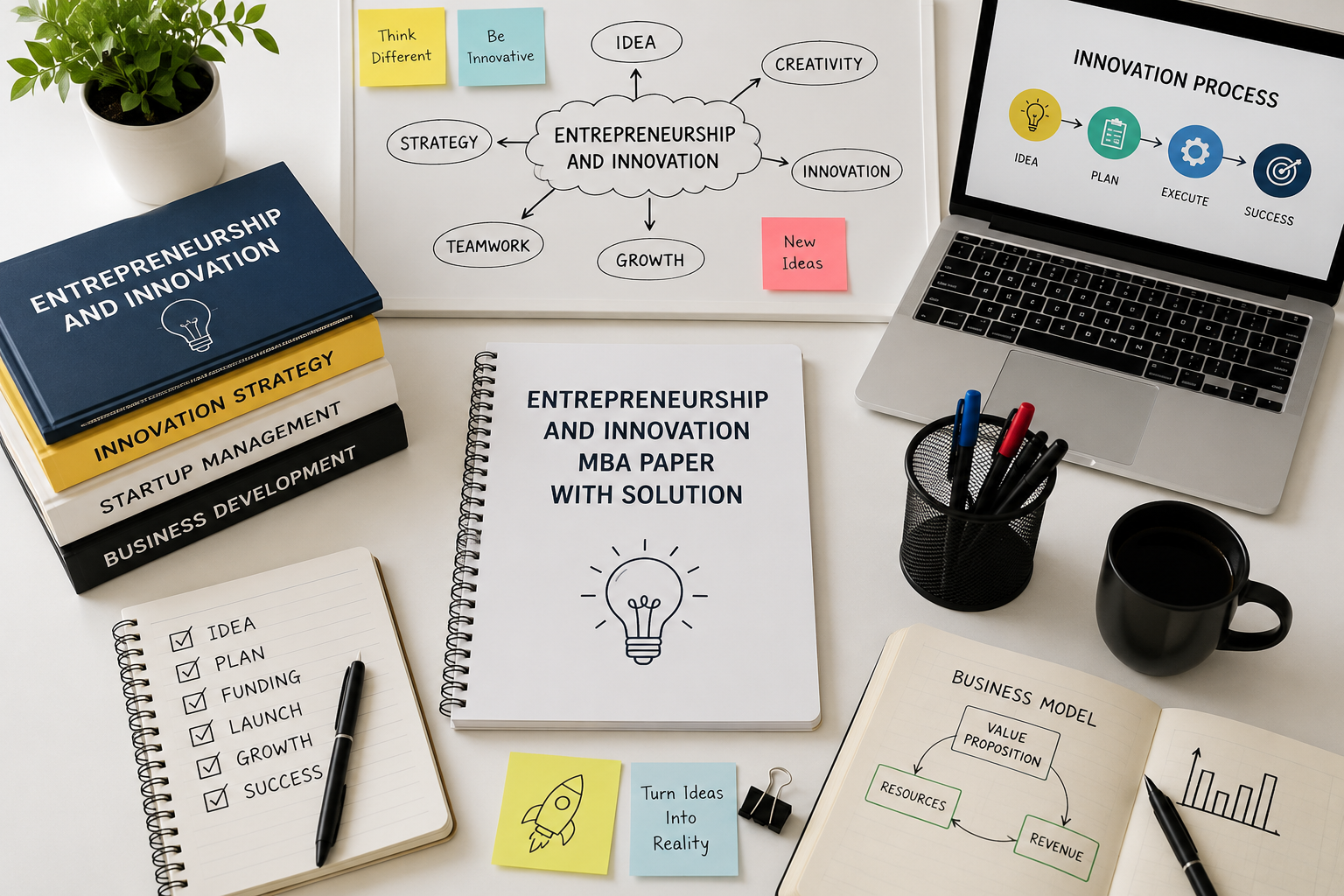
Every established company was once a small, unproven idea. Someone noticed a gap, took a real risk, and built something new around it. Entrepreneurship and Innovation MBA Paper with Solution content exists precisely to study that process — how ideas turn into functioning businesses, and how existing companies keep reinventing themselves once they’ve already succeeded.
This paper covers the core questions MBA students face on entrepreneurship and innovation. Each answer is structured, backed by real examples, and written the way you’d want to present it on an exam.
Entrepreneurship and Innovation MBA Paper with Solution
Question 1: What Is Entrepreneurship?
Entrepreneurship is the process of identifying an opportunity, organizing resources, and taking on financial risk to build a new business venture. It involves far more than just having a good idea. It requires execution, resilience, and the willingness to operate under real uncertainty.
Entrepreneurship typically involves:
- Identifying unmet market needs
- Developing a viable business model
- Securing funding and resources
- Managing risk and uncertainty
- Scaling operations as demand grows
Entrepreneurs don’t always invent something entirely new. Often, they improve on an existing idea, deliver it more efficiently, or reach a market that’s been underserved. Airbnb didn’t invent short-term lodging. It simply organized an enormous, previously informal market into something structured, searchable, and trustworthy.
Question 2: Explain the Different Types of Entrepreneurship
Not all entrepreneurial ventures look alike. Business schools typically distinguish between a few broad categories.
Small business entrepreneurship involves starting a business meant to support the owner and a small team, without necessarily seeking rapid growth. A local bakery or independent consulting firm fits this category.
Scalable startup entrepreneurship aims for rapid growth, often backed by venture capital, with the goal of capturing a large market quickly. Technology startups frequently fall into this group.
Social entrepreneurship focuses on solving social or environmental problems, with profit as a secondary goal rather than the primary one.
Corporate entrepreneurship, sometimes called intrapreneurship, involves employees within an established company developing new products or business lines internally.
Each type carries different risk profiles and growth expectations. A scalable startup accepts significant early losses in exchange for a shot at massive future growth, while a small business entrepreneur usually prioritizes steady, sustainable profitability instead.
Question 3: What Is the Entrepreneurial Process?
Most successful ventures move through a similar sequence, even though the details vary by industry.
- Idea generation — identifying a genuine problem or unmet need worth solving
- Opportunity evaluation — assessing whether the idea is viable, given market size, competition, and resource requirements
- Business planning — developing a structured plan covering operations, finances, and go-to-market strategy
- Resource acquisition — securing funding, talent, and physical or technological resources
- Launch and growth — bringing the product or service to market, then scaling based on real feedback and demand
Skipping the evaluation stage is a common mistake. Passionate founders sometimes commit resources before genuinely testing whether the market actually wants what they’re building, which often leads to painful and expensive lessons later.
Question 4: Discuss the Concept of a Business Model Canvas
The Business Model Canvas is a strategic tool used to visualize and design a business model in a single, structured framework.
Its key components include:
- Value proposition — what unique value the business offers customers
- Customer segments — who the business actually serves
- Channels — how the business reaches and delivers to customers
- Revenue streams — how the business actually makes money
- Cost structure — the major costs involved in running the business
- Key partners and resources — what external relationships and internal assets the business depends on
The canvas format forces founders to think through their entire business model on a single page, rather than burying key assumptions inside a lengthy, unfocused business plan. Many startups use it specifically to test and refine their model before committing significant capital to execution.
Question 5: What Is Innovation, and How Does It Differ from Invention?
Innovation is the process of creating value by applying new ideas, methods, or technologies in a way that customers actually adopt. Invention, by contrast, simply refers to creating something new, regardless of whether it ever reaches practical use.
The distinction matters:
- An invention can sit unused indefinitely
- Innovation requires successful adoption and real market impact
- Innovation can apply to products, processes, or entire business models
- Not every innovation requires new technology at all
Netflix’s shift from DVD rentals to streaming is a widely cited innovation example. The underlying technology already existed elsewhere. What Netflix did differently was apply it in a way that fundamentally reshaped how people consumed entertainment content.
Question 6: Explain the Types of Innovation
Innovation isn’t one single thing. MBA programs typically distinguish between several categories.
Incremental Innovation
Small, continuous improvements to existing products or processes. A smartphone manufacturer releasing a slightly improved camera each year fits this category.
Disruptive Innovation
A new product or service that initially targets a niche or overlooked market, then gradually displaces established competitors entirely. Streaming services disrupting traditional cable television is a well-known example.
Radical Innovation
A significant breakthrough that creates an entirely new market or fundamentally changes an existing one, often involving genuinely new technology.
Architectural Innovation
Reconfiguring existing components or technologies in a new way, without necessarily inventing anything entirely new individually.
Recognizing which type of innovation a business is pursuing helps shape appropriate strategy. Disruptive innovation often requires patience, since initial performance in the mainstream market may lag behind established competitors before eventually overtaking them.
Question 7: What Is the Role of Venture Capital in Entrepreneurship?
Venture capital provides funding to early-stage, high-growth-potential companies in exchange for equity ownership.
Key characteristics of venture capital include:
- High risk tolerance — investors accept that many funded startups will fail entirely
- Equity-based returns — rather than repayment with interest, investors profit through eventual ownership value
- Active involvement — many venture capital firms provide mentorship, industry connections, and strategic guidance beyond just funding
- Staged funding rounds — capital is typically released in stages, tied to specific milestones and growth targets
Venture capital isn’t right for every business. It suits ventures with genuine potential for rapid, large-scale growth, since investors expect a small number of successful investments to generate returns large enough to offset the majority that don’t succeed at all.
Question 8: What Is the Lean Startup Methodology?
The Lean Startup methodology, developed by Eric Ries, offers a structured approach for building new ventures under genuine uncertainty, minimizing wasted resources along the way. Harvard Business School’s research on hypothesis-driven entrepreneurship offers a detailed academic treatment of the approach if you want to explore it further.
Its core principles include:
- Build-Measure-Learn loop — develop a minimum viable product, measure real customer response, then learn and adjust before investing further
- Minimum Viable Product (MVP) — the simplest version of a product that still lets a team test core assumptions with real customers
- Validated learning — treating each experiment as a genuine test of a hypothesis, rather than assuming success without evidence
- Pivoting — changing strategic direction based on what validated learning actually reveals, rather than stubbornly sticking to an original plan
This methodology directly counters a common founder instinct: building a fully polished product before ever showing it to customers. Instead, it argues for testing core assumptions as early and cheaply as possible, since early mistakes are far less costly than mistakes discovered after significant capital has already been committed.
Dropbox famously validated demand for its product using a simple explainer video, well before building the full functioning product. The video alone generated enough signups to confirm genuine market interest, letting the founders commit further resources with real evidence behind the decision, rather than pure assumption.
Question 9: How Do Established Companies Sustain Innovation Over Time?
Large, established companies face a different innovation challenge than startups. They must protect a profitable core business while still finding room to experiment and grow.
Common strategies include:
- Dedicated innovation labs — separate teams insulated from the pressures and metrics of the core business, free to experiment more openly
- Acquisitions — buying smaller, innovative companies rather than building new capabilities entirely from scratch internally
- Internal incubators — structured programs allowing employees to pitch and develop new ideas with dedicated time and resources
- Strategic partnerships — collaborating with startups or research institutions to access innovation without bearing its full cost alone
Google’s approach to innovation illustrates several of these strategies working together. Its acquisition of YouTube, alongside internal experimentation through various moonshot projects, reflects a deliberate strategy of pursuing innovation through multiple channels simultaneously, rather than relying on just one approach.
Companies that fail to invest in ongoing innovation often face a slow, sometimes invisible decline. Nokia’s dominance in mobile phones eroded significantly once it fell behind on smartphone innovation, despite once being the clear global market leader in the category.
Why Entrepreneurship and Innovation Matter in MBA Programs
Entrepreneurship and Innovation MBA Paper with Solution material gives students practical frameworks for building new ventures and driving change within existing organizations alike.
Studying entrepreneurship and innovation helps students:
- Understand how to evaluate genuine business opportunities
- Build skills in resource-constrained decision-making
- Learn structured frameworks for testing and validating new ideas
- Prepare for both startup ventures and corporate innovation roles
- Appreciate how established companies must keep innovating to avoid decline
This connects closely to the strategic thinking covered in our Strategic Management MBA paper, since building and sustaining a competitive venture requires the same disciplined strategic reasoning, whether the company is brand new or decades old.
A Practical Example: Testing an Idea Before Scaling
Consider a small team developing a subscription meal-kit service targeting busy professionals. Rather than building a full national operation immediately, the founders launch a limited pilot in a single city.
They deliberately keep the initial offering small, testing just three meal options weekly. Early customer feedback reveals a clear pattern. Customers love the convenience, but portion sizes feel inconsistent, and delivery windows are too unpredictable for people juggling demanding work schedules.
Rather than scaling immediately, the team spends two additional months refining logistics and standardizing portions before expanding to a second city. This measured approach costs valuable early time, but it prevents the far more expensive mistake of scaling a flawed operational model across multiple markets simultaneously.
Eighteen months later, the company operates in twelve cities, with a churn rate meaningfully lower than competitors who expanded faster without first validating their operational model. The lesson holds broadly. Testing assumptions early, even at the cost of slower initial growth, often produces stronger long-term outcomes than rushing straight to scale.
Common Challenges in Entrepreneurship and Innovation
Securing Adequate Funding
Many promising ventures struggle simply because they run out of capital before reaching sustainable revenue, regardless of how strong the underlying idea actually is.
Market Validation
Founders sometimes fall in love with their own idea without genuinely testing whether real customers want it enough to pay for it.
Talent Acquisition
Early-stage ventures often struggle to attract skilled talent, since they can rarely match the compensation and stability that established companies offer.
Balancing Innovation with Core Operations
Established companies pursuing corporate innovation often struggle to balance new initiatives against the demands of protecting and maintaining their existing, profitable core business.
Managing Intellectual Property and Competitive Copying
Innovative products and ideas can be copied quickly once they prove successful in the market. Founders often face a genuine tradeoff between moving fast to capture early market share and investing time in protecting their innovations through patents or other legal mechanisms, particularly when resources are limited in the early stages of a venture.
Tips to Write Strong Entrepreneurship and Innovation MBA Answers
Use Real Startup and Company Examples
Referencing how companies like Airbnb, Netflix, or well-documented startup case studies illustrate specific concepts shows applied understanding, not just memorized theory.
Distinguish Between Innovation Types Clearly
Many exam answers blur incremental, disruptive, and radical innovation together. Keeping these categories clearly separated demonstrates a stronger grasp of the material.
Show Awareness of Risk and Uncertainty
Strong answers acknowledge that entrepreneurship involves genuine uncertainty, rather than presenting venture success as a predictable, guaranteed outcome.
Reference Structured Frameworks
Bringing in tools like the Business Model Canvas or the entrepreneurial process gives an answer clear structure and academic weight, rather than a loose narrative.
FAQs
What is the main difference between entrepreneurship and small business ownership?
Entrepreneurship often implies innovation and significant growth ambition, while small business ownership can involve running a stable, established business model without necessarily pursuing rapid expansion.
Why is market validation so important before scaling a business?
Because scaling a flawed or unproven business model amplifies existing problems, making mistakes far more costly than they would have been at a smaller, more manageable scale.
What’s the difference between incremental and disruptive innovation?
Incremental innovation involves small, ongoing improvements to existing offerings, while disruptive innovation introduces something that eventually displaces established competitors entirely, often starting in a niche market.
How does venture capital funding actually work?
Investors provide capital in exchange for equity ownership, accepting that many funded ventures will fail, in exchange for the potential of outsized returns from the ventures that succeed.
Is entrepreneurship relevant to students who plan to work at large companies?
Yes. Corporate entrepreneurship, or intrapreneurship, is increasingly valued at established companies seeking to innovate internally, making these skills broadly relevant beyond startup founders specifically.
What is a Minimum Viable Product, and why does it matter?
A Minimum Viable Product is the simplest possible version of a product that still allows a team to test its core assumptions with real customers. It matters because it lets founders gather genuine market feedback quickly and cheaply, rather than investing significant time and capital into a fully built product before confirming that real demand actually exists.
How do large companies avoid losing their innovative edge over time?
By deliberately investing in structured innovation efforts, whether through dedicated labs, strategic acquisitions, internal incubator programs, or partnerships with startups, rather than assuming past success alone will sustain future competitiveness. Companies that neglect this often find themselves outpaced by smaller, more agile competitors willing to take risks the established players have grown reluctant to pursue.
Final Verdict
Entrepreneurship and Innovation MBA Paper with Solution material reflects a subject built around a simple but demanding truth: good ideas alone rarely succeed without disciplined execution behind them. Understanding how to evaluate opportunities, test assumptions, and manage genuine uncertainty gives MBA students tools that apply whether they eventually found a company or drive innovation from within an established one. Markets reward founders and companies willing to test, learn, and adapt quickly, rather than those who simply execute a fixed plan without ever pausing to question its underlying assumptions along the way. That kind of grounded, practical thinking holds genuinely real value across nearly every business path available today, from early-stage founders to senior leaders inside long-established corporations.