A handshake deal can fall apart fast if nobody understands the legal ground they’re standing on. Contracts get broken. Products get recalled. Partnerships turn into disputes. Business law exists to give companies a framework for handling exactly these situations, before they turn into a crisis.
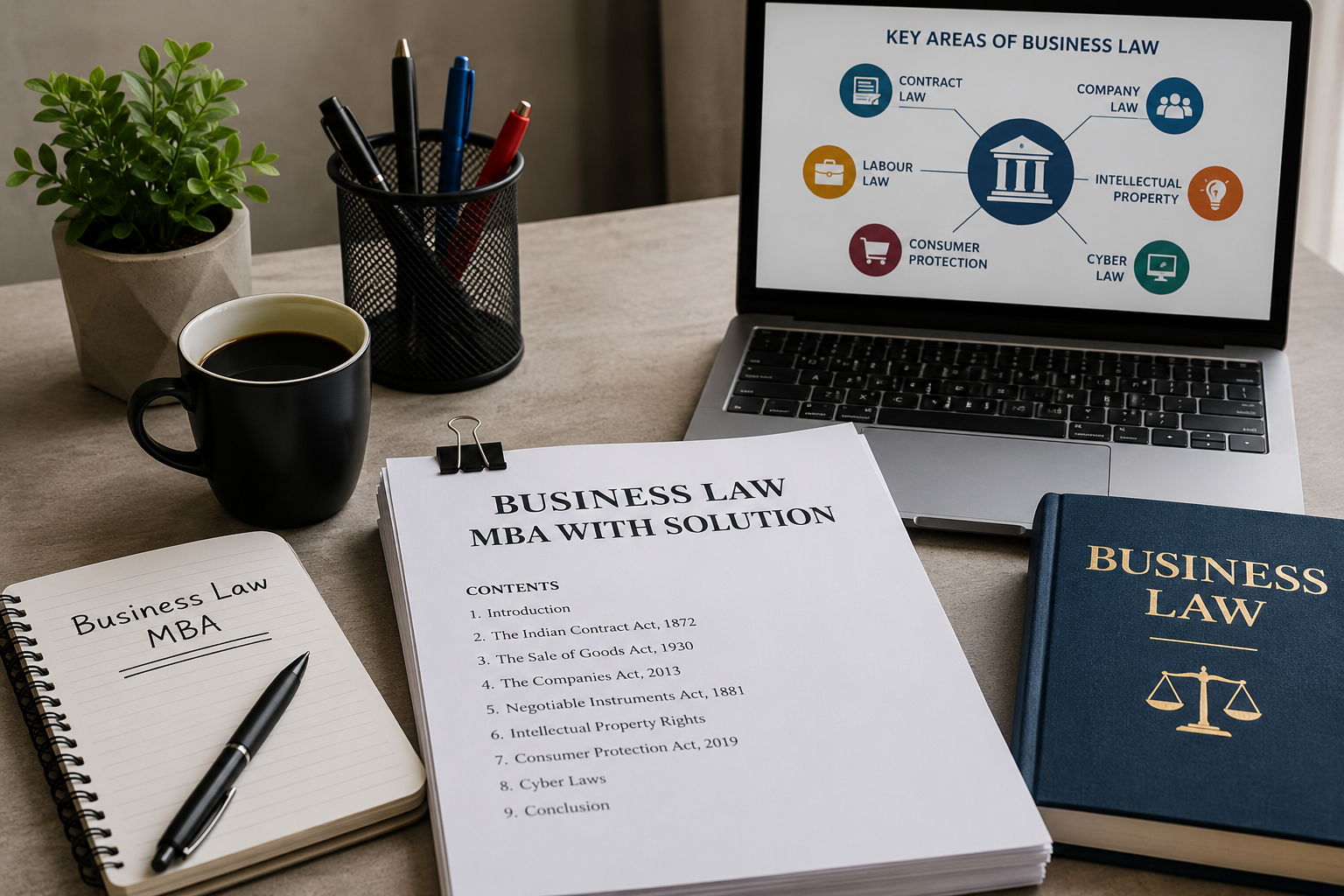
This Business Law MBA Paper with Solution covers the core questions MBA students face on the subject. Each answer is structured, backed by real examples, and written the way you’d want to present it on an exam.
Business Law MBA Paper with Solution
Question 1: What Is Business Law?
Business law refers to the body of laws that govern commercial transactions, business formation, and the relationships between companies, employees, and customers. It covers everything from contracts to intellectual property to employment regulations.
Business law typically covers:
- Contract law
- Corporate and business formation law
- Employment law
- Intellectual property law
- Consumer protection law
- Torts and liability
Every business, regardless of size, operates within this legal framework. A company that ignores it doesn’t get to skip the rules. It just gets exposed to risks it doesn’t understand until something goes wrong.
Question 2: Explain the Elements of a Valid Contract
Contracts are the backbone of most business relationships. For a contract to be legally enforceable, it generally needs several key elements.
Offer is the starting point. One party proposes specific terms to another.
Acceptance follows. The other party agrees to those exact terms, without changing them.
Consideration means something of value gets exchanged. This could be money, goods, services, or a promise to do something.
Capacity refers to both parties having the legal ability to enter a contract. Minors and people deemed legally incompetent generally can’t form binding contracts.
Legality means the contract’s purpose must be lawful. A contract to do something illegal isn’t enforceable, no matter how clearly it’s written.
Missing even one of these elements can make a contract void or unenforceable. A written agreement that skips consideration, for example, might not hold up in court, regardless of how formal it looks. Cornell Law School’s Legal Information Institute offers a detailed academic breakdown of contract law if you want to explore further.
Question 3: Discuss the Different Types of Business Organizations
Choosing the right business structure shapes everything from liability exposure to tax treatment.
Sole Proprietorship
Owned and run by one person, with no legal separation between the owner and the business. Simple to set up, but the owner carries unlimited personal liability.
Partnership
Owned by two or more people who share profits, losses, and responsibilities. General partnerships carry unlimited liability, while limited partnerships offer some protection to certain partners.
Corporation
A separate legal entity from its owners, offering liability protection but requiring more formal governance and reporting.
Limited Liability Company (LLC)
Combines liability protection similar to a corporation with simpler management and tax flexibility, making it a popular choice for small and mid-sized businesses.
Each structure carries different legal and tax implications. A startup expecting to raise venture capital, for instance, often incorporates specifically because investors typically prefer the corporate structure over an LLC or partnership.
Question 4: What Is Intellectual Property, and Why Does It Matter in Business?
Intellectual property refers to creations of the mind — inventions, designs, brand names, written works — that receive legal protection.
The main categories include:
- Patents — protect inventions and new processes for a limited period
- Trademarks — protect brand names, logos, and slogans
- Copyrights — protect original creative works, like writing, music, and software
- Trade secrets — protect confidential business information, like formulas or processes, as long as they stay secret
Without intellectual property protection, competitors could copy a company’s innovations freely. Coca-Cola’s formula is a famous example of a trade secret protected for over a century, precisely because the company chose secrecy over patenting, which would have required public disclosure.
Question 5: Explain the Concept of Torts in Business Law
A tort is a civil wrong that causes harm or loss, resulting in legal liability for the person or business responsible. Torts differ from criminal law, since they involve private disputes rather than government prosecution.
Common business-related torts include:
- Negligence — failing to exercise reasonable care, resulting in harm to another party
- Product liability — holding manufacturers responsible for defective or dangerous products
- Defamation — making false statements that damage a person’s or company’s reputation
- Fraud — intentionally deceiving someone for financial or personal gain
A company that sells a defective product, resulting in customer injury, could face a product liability claim even without any intent to cause harm. Negligence alone is often enough to establish liability.
Question 6: What Is Employment Law, and What Does It Cover?
Employment law governs the relationship between employers and employees, covering everything from hiring to termination.
Key areas include:
- Wage and hour laws — regulate minimum pay, overtime, and working hours
- Anti-discrimination laws — prohibit unfair treatment based on race, gender, age, disability, or other protected characteristics
- Workplace safety regulations — set standards for safe working conditions
- Wrongful termination protections — prevent employees from being fired for illegal reasons, like retaliation or discrimination
Companies that violate employment law face real financial and reputational consequences. Lawsuits over workplace discrimination or unsafe conditions can be costly, both in settlements and in the damage done to a company’s public image.
Question 7: Discuss the Role of Consumer Protection Law
Consumer protection law exists to prevent unfair, deceptive, or fraudulent business practices that harm customers.
Common consumer protection areas include:
- Truth in advertising — prohibits false or misleading claims about products
- Product safety standards — require products to meet minimum safety requirements
- Warranty protections — ensure consumers receive what was promised regarding product quality and performance
- Data privacy regulations — govern how businesses collect, store, and use customer information
Regulatory bodies actively enforce these protections, and violations can result in significant fines. A company caught making false advertising claims, for example, risks both legal penalties and lasting damage to consumer trust.
Question 8: What Are the Common Methods of Resolving Business Disputes?
Not every business disagreement ends up in court. Several dispute resolution methods exist, each with different costs and timelines.
Negotiation is usually the first step. The parties involved try to resolve the issue directly, without outside involvement.
Mediation brings in a neutral third party to help facilitate a resolution. The mediator doesn’t make a binding decision, but helps both sides reach a mutually acceptable agreement.
Arbitration involves a neutral arbitrator who reviews the dispute and issues a binding decision. It’s generally faster and less expensive than litigation, and many commercial contracts specifically require arbitration before allowing a lawsuit.
Litigation is the most formal option, involving a court process with a judge or jury deciding the outcome. It’s typically the most expensive and time-consuming path, often taking months or years to resolve.
Many businesses now include arbitration or mediation clauses directly in their contracts, specifically to avoid the cost and unpredictability of litigation. A well-drafted contract often specifies exactly which method applies before a dispute even arises, which can save both parties significant time and legal expense down the road.
Why Business Law Matters in MBA Programs
Nearly every business decision carries some legal dimension, making this Business Law MBA Paper with Solution relevant well beyond students planning careers in law specifically.
Studying business law helps students:
- Understand the legal risks tied to everyday business decisions
- Learn to read and negotiate contracts with more confidence
- Recognize when a situation calls for professional legal advice
- Prepare for leadership roles that require legal awareness
- Appreciate how regulation shapes competitive strategy across industries
This connects closely to the risk assessment thinking covered in our Risk Management and Insurance MBA paper, since legal exposure is one of the core risk categories every business has to actively manage.
A Practical Example: Contract Disputes in Action
Consider a mid-sized manufacturer that signs a supply agreement with a new vendor. The contract specifies delivery within thirty days, at a fixed price per unit.
The vendor delivers late, missing the agreed deadline by three weeks. The manufacturer, relying on that shipment for a major customer order, loses the sale as a direct result. Because the contract clearly specified delivery terms, and both parties had the legal capacity to enter the agreement, the manufacturer has solid grounds to pursue a breach of contract claim.
Rather than heading straight to litigation, the manufacturer’s legal team reviews the contract’s dispute resolution clause, which requires mediation before any lawsuit can proceed. Mediation resolves the dispute in six weeks, with the vendor agreeing to a partial refund and a revised delivery schedule going forward.
This example shows why contract details matter so much. A well-drafted agreement, with clear terms and a defined dispute resolution process, gave the manufacturer a much faster and less costly path to resolution than an open-ended legal battle would have.
Common Challenges in Business Law
Keeping Up with Regulatory Change
Laws and regulations shift regularly across industries and regions, and staying compliant takes ongoing attention that many companies underinvest in.
Cross-Border Legal Complexity
Businesses operating internationally face different legal systems in each market, making compliance significantly more complex than operating in a single jurisdiction.
Balancing Legal Caution with Business Speed
Overly cautious legal review can slow down business decisions, while moving too fast without proper legal review creates real risk exposure.
Protecting Intellectual Property Globally
Intellectual property protections vary by country, and enforcing rights internationally can be far more difficult than protecting them domestically.
Managing Contractual Risk with New Partners
Entering agreements with unfamiliar vendors or partners carries inherent risk, since past performance and reliability are harder to verify without an established relationship. Businesses often mitigate this through smaller initial contracts, performance clauses, or requiring references before committing to larger agreements.
Tips to Write Strong Business Law MBA Answers
Use Real Legal Cases and Examples
Referencing well-known legal disputes or company examples shows applied understanding, not just memorized definitions.
Explain the Practical Business Impact
Don’t just define a legal concept. Explain how it actually affects business decisions, risk, and strategy.
Reference the Elements Clearly
Legal concepts like contract formation often involve specific required elements. Listing them clearly tends to score better than a general description.
Keep Structure Simple and Organized
Business law questions often involve categories or processes. Clear headings and short paragraphs make answers easier to follow and easier to grade well.
Distinguish Between Legal Concepts Precisely
Exam answers often lose marks when concepts get blurred together, like confusing a tort with a breach of contract. Being precise about definitions, even briefly, signals a stronger grasp of the material to anyone grading the response.
FAQs
What is the main purpose of business law?
The main purpose is to provide a legal framework governing commercial transactions, business relationships, and the rights and responsibilities of everyone involved.
What makes a contract legally enforceable?
A valid contract generally requires an offer, acceptance, consideration, legal capacity of both parties, and a lawful purpose.
Why does choosing the right business structure matter?
Because it directly affects liability exposure, tax treatment, and how much formal governance and reporting a business is required to maintain.
What’s the difference between a tort and a crime in business law?
A tort is a civil wrong resulting in private legal liability, while a crime involves government prosecution and potential criminal penalties.
Is business law relevant to non-legal MBA careers?
Yes. Nearly every management decision carries some legal dimension, making a basic understanding of business law valuable across virtually every career path.
What happens if a business operates without the right legal structure in place?
Operating informally, without a properly registered business structure, can expose owners to personal liability for business debts and legal claims, since the legal separation that structures like an LLC or corporation provide simply doesn’t exist without proper registration.
Can a verbal agreement count as a legally binding contract?
In many cases, yes, as long as it includes the core elements of offer, acceptance, and consideration. However, certain contracts, like real estate transactions or agreements lasting longer than a year, generally must be in writing to be enforceable.
Final Verdict
This Business Law MBA Paper with Solution reflects a subject that touches nearly every part of running a business, whether or not a career path leads toward law specifically. Contracts, employment decisions, intellectual property, and consumer protection all carry real legal weight, and businesses that understand these fundamentals tend to avoid costly mistakes that catch less prepared competitors off guard. For MBA students, that legal awareness isn’t just academic. It’s a genuinely practical skill that pays off across almost any leadership role.