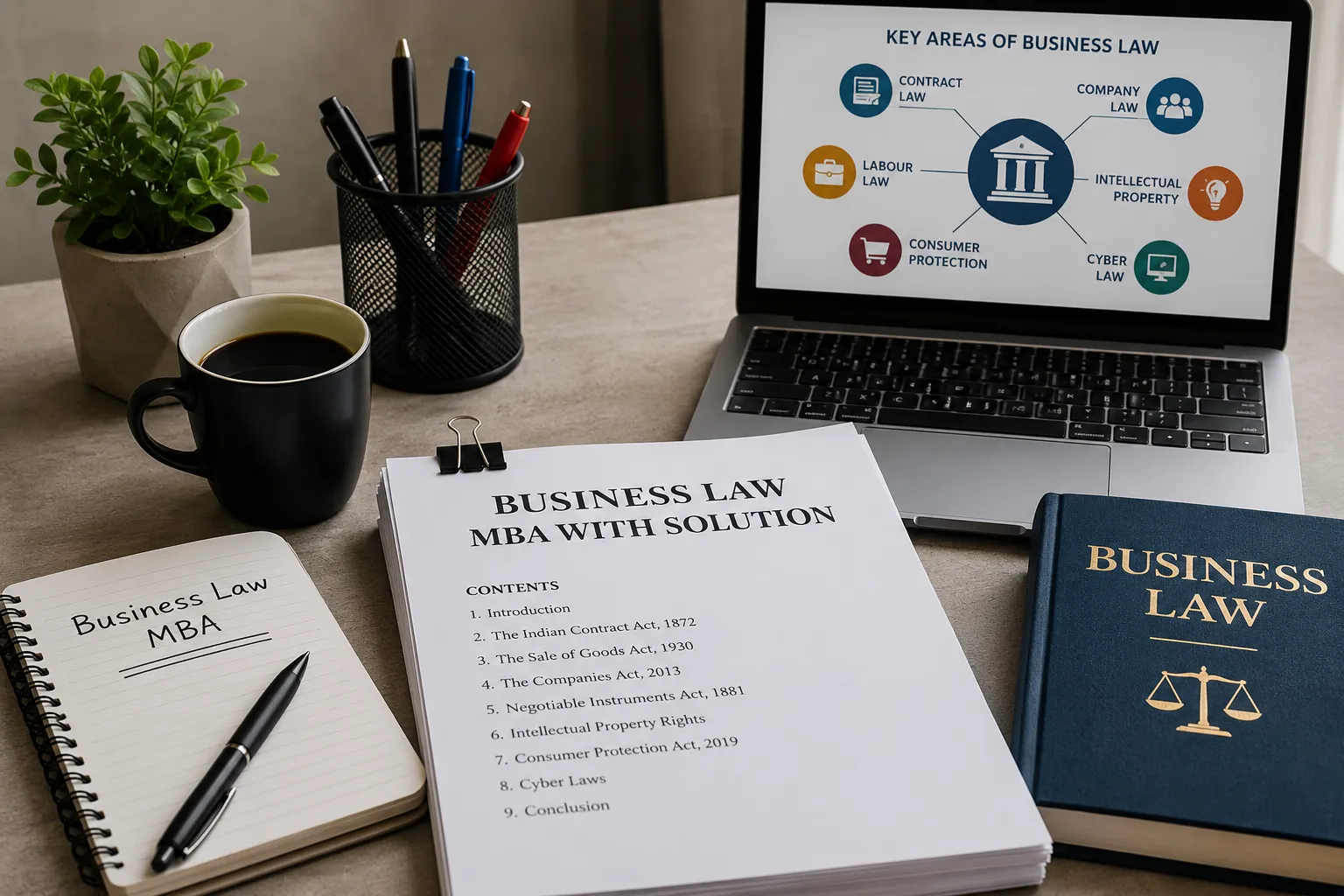
Moreover, business law is the subject MBA students most often underestimate — until they sign their first bad contract. Almost every managerial decision has a legal skeleton underneath it, and the examiner’s favourite questions test whether you can find it: is this agreement binding, who bears this loss, which structure protects this founder? This paper works through contracts, remedies, business structures, intellectual property, employment and consumer law in that spirit, with two disputes analysed the way a court would analyse them.
Question 1: What Is Business Law, and Why Does a Manager Need It?
Moreover, business law is the body of rules governing commercial activity. Furthermore, it covers how agreements are made and enforced. In addition, it covers how businesses are formed, what employers owe employees, what sellers owe buyers, and how disputes are settled. For example, its sources include legislation, court decisions (precedent), and contract terms.
In addition, two distinctions organise the whole subject. The first is civil versus criminal: a business that breaks a contract faces a civil claim from the other party, usually for money, while a business that commits fraud faces the state in a criminal case. Therefore, the second is law versus ethics: much lawful behaviour can still be unethical. For example, this is why this paper pairs naturally with our Business Ethics and Governance MBA paper. However, a manager needs business law to draft agreements that protect the firm. Consequently, it also helps spot legal risk before signing rather than after.
Question 2: What Makes a Contract Legally Binding?
Similarly, a contract is an agreement the law will enforce. Meanwhile, five elements must all be present. In short, if any one is missing, there may be a deal but no contract in the legal sense.
- Offer — a definite proposal, clear enough to be accepted as it stands. An advertisement or price list is usually only an “invitation to treat” — an invitation to make an offer — not an offer itself.
- Acceptance — the other party agrees to the offer exactly as made. Silence is not acceptance, and a changed term is a counter-offer, not an acceptance.
- Consideration — each side gives something of value: money, goods, services, or a promise. A one-sided promise is generally unenforceable.
- Intention to create legal relations — presumed in business; presumed absent in family and social arrangements unless shown otherwise.
- Capacity and legality — the parties must be legally able to contract (adults of sound mind, companies acting within their powers) and the purpose must be lawful.
Worked Example 1: A Late Delivery, Tested Element by Element
Meridian Office Supplies, a fictional retailer, orders 200 chairs from Oakline Furniture at $150 each — a contract value of 200 × $150 = $30,000 — with delivery promised by 1 March and a clause charging $100 for each day of late delivery. Therefore, the chairs arrive thirty days late and Meridian withholds $3,000; Oakline sues for the full price. Moreover, apply the structure a court uses: issue, rule, application, outcome.
| Element | Rule | Application to the Facts |
|---|---|---|
| Offer | A definite proposal capable of acceptance | Oakline’s written quotation: 200 chairs, $150 each, delivery 1 March |
| Acceptance | Agreement to the offer exactly as made | Meridian’s signed purchase order accepting those terms |
| Consideration | Something of value from each side | Chairs from Oakline; $30,000 from Meridian |
| Intention | Presumed in commercial dealings | Two businesses, written terms — presumed present |
| Capacity and legality | Parties able to contract; lawful purpose | Both registered companies; an ordinary sale of goods |
However, all five elements are present, so a valid contract existed — which is why the late-delivery clause matters. Furthermore, the clause fixed damages in advance at $100 per day. The deduction is 30 days × $100 = $3,000, provided the sum is a genuine pre-estimate of loss rather than a punishment. Consequently, a modest daily rate on a $30,000 order would normally pass that test. In addition, Outcome: Meridian owes $30,000 − $3,000 = $27,000. Similarly, examiners award the marks for matching each element to a fact, not for reciting the list.
Case in Point: Nadia’s Verbal Deal With Her Packaging Supplier
For example, Nadia Rahman runs a fictional small cosmetics brand. On a phone call, her packaging supplier agrees to supply 5,000 printed boxes at an agreed price, then denies the conversation ever happened when a cheaper buyer appears. Meanwhile, students often assume Nadia has no case because nothing was written down. Therefore, the law says otherwise: most contracts need no particular form. In short, a spoken agreement can bind if the five elements are present. Offer and acceptance happened on the call, and consideration was the boxes and the price. Moreover, her real problem is evidence, not validity. Her follow-up email (“Confirming our call — 5,000 boxes as agreed”) becomes the decisive document. The lesson examiners want: verbal deals are legally real but commercially fragile, so confirm them in writing within the hour.
Question 3: What Happens When a Contract Is Broken?
A breach occurs when a party fails to perform as promised — delivering late, delivering the wrong goods, or refusing to perform at all. Furthermore, the innocent party’s main remedy is damages. The damages aim to put them in the position they would have occupied if the contract had been performed. In addition, two limiting rules decide how much is recoverable, and both must be stated before any figures are used.
- Remoteness: losses are recoverable only if they arise naturally from the breach or were within the parties’ reasonable contemplation when the contract was made. Unusual losses the breaching party knew nothing about are too remote.
- Mitigation: the innocent party must take reasonable steps to reduce their loss; they cannot sit back and let damages grow.
Worked Example 2: Foreseeable and Unforeseeable Losses at a Bakery
Crumb & Craft, a fictional bakery, orders a replacement oven motor from a supplier, who delivers ten days late despite knowing the bakery cannot trade without it. The bakery claims two losses: $12,000 of ordinary trading profit lost during the closure. For example, $40,000 from a one-off wedding contract it had to cancel. A contract the supplier was never told about. Therefore, total claimed: $52,000.
| Loss Claimed | Amount | Foreseeable at Contracting? | Recoverable |
|---|---|---|---|
| Ordinary trading profit during closure | $12,000 | Yes — supplier knew the bakery could not trade without the motor | $12,000 |
| Cancelled one-off wedding contract | $40,000 | No — never communicated to the supplier | $0 |
| Total | $52,000 | $12,000 |
The bakery recovers $12,000, not $52,000. Other remedies complete the picture: specific performance (a court order to perform) is rare and reserved for unique goods or land; rescission unwinds a contract induced by misrepresentation; and an injunction restrains a threatened breach. However, in an exam: name the remedy, apply remoteness and mitigation, then quantify.
Question 4: Which Business Structure Should a Founder Choose?
The choice of structure decides who is liable when things go wrong. It is the first legal decision any founder makes — developed from the founder’s side in our Entrepreneurship and Innovation MBA paper.
| Feature | Sole Trader | Partnership | Limited Company |
|---|---|---|---|
| Liability | Unlimited — owner personally liable | Unlimited, and each partner liable for the others | Limited to the amount invested |
| Separate legal identity | No | Usually no | Yes — the company can own, sue and be sued |
| Set-up and administration | Minimal | Partnership agreement strongly advised | Registration, filings, annual accounts |
| Raising finance | Owner’s funds and bank lending | Partners’ capital | Shares can be sold to investors |
Consequently, the pattern to state in an answer: limited liability is bought with administration. A company shields the founder’s home and savings behind a legal identity, but demands registration and public filings in exchange. Examiners reward students who match the structure to the venture’s risk and ambition rather than naming one form “best” in the abstract.
Question 5: How Does Intellectual Property Protect a Business?
Intellectual property (IP) law protects creations of the mind that carry commercial value. Similarly, four rights cover most exam questions. Trademarks protect signs that distinguish one trader’s goods — names, logos, slogans — and last indefinitely while renewed and used. Patents protect new inventions for a limited term (commonly twenty years) in exchange for publishing how the invention works. Meanwhile, Copyright protects original creative work — text, software, designs, music — arising automatically in most countries. Trade secrets protect valuable know-how, such as a recipe or a pricing algorithm, for as long as secrecy lasts.
In short, the business logic is what examiners probe. IP converts ideas into assets that can be licensed or sold. Those assets keep imitators out while a brand is built. It also cuts both ways. A growing firm must check its own name and designs against other people’s rights before launch. This matters because innocent infringement is still infringement.
Question 6: What Does Employment Law Require of Employers?
Employment law governs the relationship between a business and the people it hires. It rests on the employment contract — terms covering pay, hours, duties and notice — supplemented by statutory minimums the contract cannot undercut, such as minimum wage and protection against discrimination. Furthermore, the operational detail sits in our Human Resource Management MBA paper; the legal spine is what matters here.
Three areas dominate exam papers. Dismissal: ending employment lawfully requires a fair reason (conduct, capability, redundancy) and a fair procedure — an employer who skips the process can lose even with a good reason. Discrimination: decisions on hiring, pay and promotion must not rest on protected characteristics such as sex, race, age or disability. In addition, Status: whether someone is an employee or a genuine independent contractor decides which rights they hold. The contract’s label does not settle it — the reality of the relationship does.
Question 7: What Does Consumer Protection Law Demand of Sellers?
Consumer protection law corrects the imbalance between a business and an individual buyer, who cannot inspect goods like a trade purchaser or negotiate terms. For example, its core requirements in most jurisdictions are these. Goods must match their description, be of satisfactory quality and fit for their stated purpose. Services must be performed with reasonable care and skill. Terms creating a significant imbalance against the consumer may be unenforceable as unfair.
Remedies follow a ladder: a short-term right to reject faulty goods for a refund, then repair or replacement, then a price reduction or final refund if those fail. Alongside the law of the sale sits the law of selling: misleading advertising, fake discounts. However, hidden charges are prohibited whether or not any consumer complains. For MBA answers, connect the law to strategy: consumer rights are a floor, and firms that treat them as a ceiling hand an advantage to competitors whose returns policy is a marketing asset.
Question 8: How Are Business Disputes Resolved Without Going to Court?
Litigation is the slowest and usually most expensive way to settle a dispute, so businesses climb a ladder of alternatives first — the same ladder analysed from the negotiator’s side in our Negotiation and Conflict Resolution MBA paper.
- Negotiation — the parties settle directly. Cheapest, most private, and it preserves the relationship, but it fails when trust has already gone.
- Mediation — a neutral third party helps the parties reach their own settlement. The mediator decides nothing, which is why mediated settlements are usually honoured voluntarily.
- Arbitration — a private tribunal hears both sides and issues a binding decision: faster and more confidential than court, and common in construction and international contracts, where parties choose it in advance by an arbitration clause.
- Litigation — the court route: binding and precedent-setting, but slow, costly and public.
Well-drafted contracts plan for failure by naming the ladder in advance — negotiate for thirty days, then mediate, then arbitrate. The exam point is comparative: choose the method by cost, speed, confidentiality and whether the relationship must survive.
Frequently Asked Questions
Can a verbal agreement really be a binding contract?
Consequently, yes, in most situations. If offer, acceptance, consideration, intention and capacity are present, a spoken agreement binds just as a written one does. Similarly, the difficulty is proving what was said, which is why businesses confirm oral deals in writing at once.
What is the difference between an offer and an invitation to treat?
An offer can be accepted to form a contract immediately. An invitation to treat — a shop display, an advertisement, a price list — merely invites the other side to make an offer, which the seller may accept or refuse. Meanwhile, the distinction decides who holds the power of acceptance.
Why would a business choose arbitration over court?
For privacy, speed and expertise: the hearing is confidential, the arbitrator can be an industry specialist. In short, the decision is binding and widely enforceable across borders. The trade-offs are cost — the parties pay the arbitrator — and very limited rights of appeal.
Does forming a limited company remove all personal risk for a founder?
No. Moreover, limited liability covers ordinary trading debts up to the amount invested, but founders routinely give personal guarantees on loans. Directors can be personally liable for wrongful or fraudulent trading. Furthermore, the shield is real but not absolute.
Law as a Manager’s Toolkit, Not a Lawyer’s Monopoly
Legal marks follow a method, not memorisation: name the rule, match it to the facts, state the outcome. A manager who can test a contract element by element, price a breach by foreseeability and pick a dispute process by purpose will handle both the exam and the first real contract their employer hands them.
2 thoughts on “Business Law MBA Paper with Solution”