Walk into two companies with nearly identical business models, and you’ll often find wildly different cultures — one where people seem genuinely engaged, and another where everyone’s just counting down to five o’clock. The difference usually isn’t strategy or funding. It’s organizational behavior — the study of how individuals and groups actually act within a company, and why.
This paper covers the core questions MBA students typically encounter on organizational behavior, answered the way you’d want to present them on an exam — structured, grounded in real examples, and without unnecessary filler.
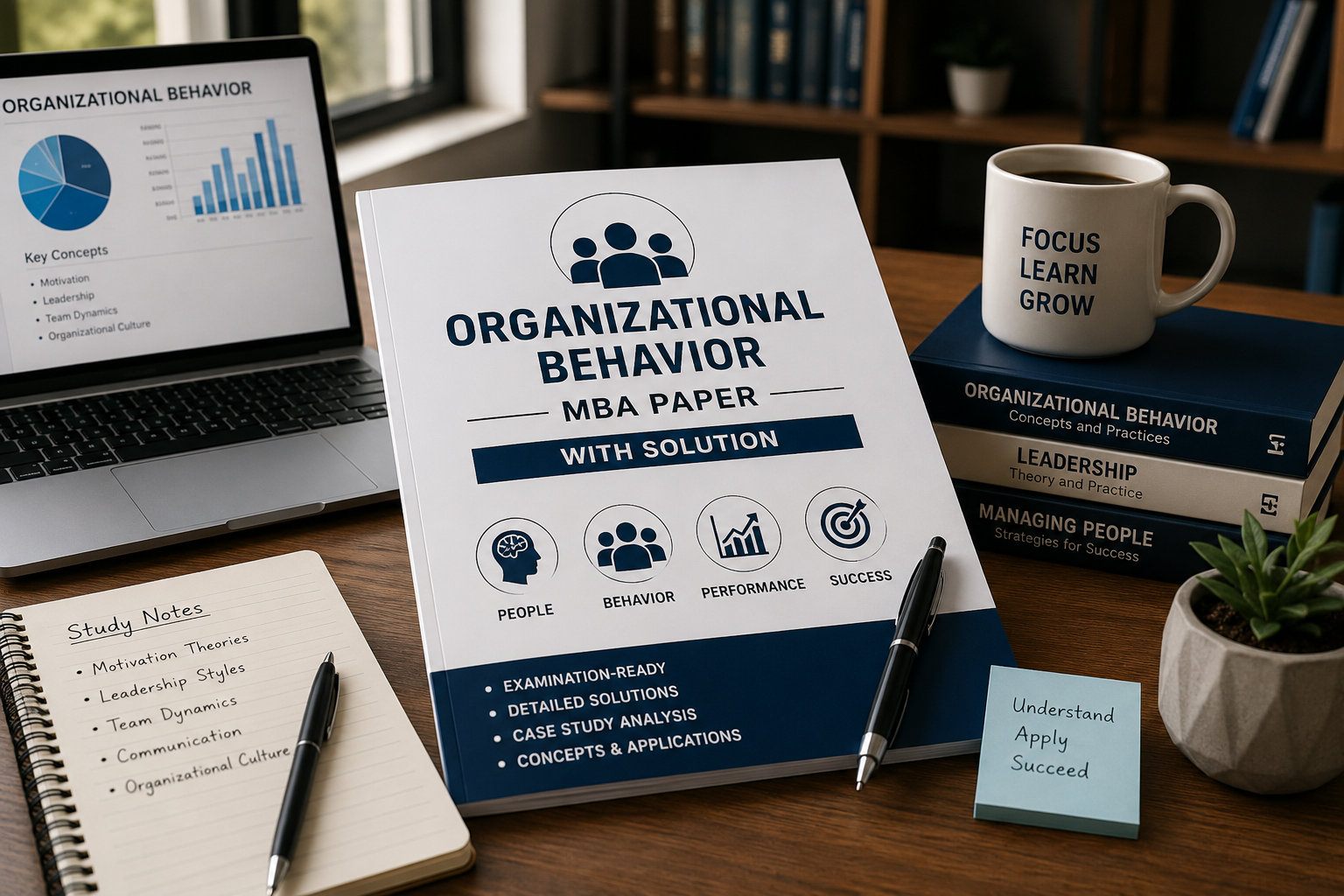
Organizational Behavior MBA Paper with Solution
Question 1: What Is Organizational Behavior?
Organizational behavior, often shortened to OB, is the study of how individuals and groups behave within an organization, and how that behavior affects overall performance. It draws from psychology, sociology, and management theory to explain why people act the way they do at work — and, more usefully, how leaders can shape that behavior toward better outcomes.
OB typically examines behavior at three levels:
- Individual level — personality, perception, motivation, attitudes
- Group level — team dynamics, communication, leadership
- Organizational level — culture, structure, change management
Understanding OB matters because a company’s formal strategy only gets executed through people, and people don’t always behave the way an org chart assumes they will.
Question 2: Explain the Key Elements of Organizational Behavior
OB isn’t a single concept — it’s a set of interconnected factors that shape how work actually gets done.
Individual behavior covers personality traits, values, and attitudes that employees bring with them, all of which influence how they respond to tasks, feedback, and colleagues.
Perception shapes how employees interpret events at work. Two people can witness the same meeting and walk away with completely different impressions, based on their own biases and past experiences.
Motivation determines how much effort people put into their work, which is why understanding what actually drives it matters so much to managers.
Group dynamics examine how teams form, communicate, and sometimes conflict — a well-functioning team can outperform a group of talented individuals working in isolation.
Organizational culture is the shared set of values and norms that shape “how things are done” in a company, often invisibly but powerfully.
Netflix is a frequently cited example — their deliberately unconventional culture, built around high autonomy and direct feedback, is often credited as central to both their innovation and their reputation as a demanding place to work.
Question 3: Discuss the Major Theories of Motivation in OB
Motivation theory sits at the heart of organizational behavior, and MBA papers lean on it heavily.
Maslow’s Hierarchy of Needs
Employees are motivated by a progression of needs — physiological, safety, social, esteem, and self-actualization — and unmet lower-level needs tend to dominate behavior until they’re addressed.
Herzberg’s Two-Factor Theory
Herzberg separated “hygiene factors” (salary, working conditions) that prevent dissatisfaction from “motivators” (achievement, recognition, growth) that actually drive engagement — a distinction that explains why pay raises alone rarely fix a disengaged team.
McGregor’s Theory X and Theory Y
Theory X assumes employees are inherently unmotivated and need close supervision, while Theory Y assumes people are naturally driven and thrive with autonomy. Most modern management leans toward Theory Y assumptions, at least in principle.
Vroom’s Expectancy Theory
This theory argues that motivation depends on whether employees believe effort will lead to performance, and whether that performance will actually lead to a valued reward. Break that chain anywhere, and motivation drops.
Question 4: What Is Organizational Culture? Explain Its Types
Organizational culture is the collection of shared values, beliefs, and behavioral norms that shape how employees interact and make decisions, often without anyone explicitly writing the rules down.
Clan Culture
Feels like an extended family — collaborative, mentorship-driven, focused on employee development and loyalty.
Adhocracy Culture
Emphasizes innovation, risk-taking, and adaptability — common in startups and tech companies pushing rapid product development.
Market Culture
Results-driven and competitive, with a strong focus on hitting targets and outperforming rivals.
Hierarchy Culture
Structured and process-oriented, valuing stability, consistency, and clearly defined procedures — common in large, regulated industries like banking or government.
Most real organizations blend elements of more than one type, but usually lean strongly toward one dominant style.
Question 5: Explain Group Dynamics and Team Development
Group dynamics refers to the patterns of interaction, influence, and behavior that emerge within a team over time.
Bruce Tuckman’s well-known model outlines how teams typically develop, and MindTools’ explainer on Tuckman’s stages of team development is a solid reference if you want more depth on the original framework:
- Forming — members get acquainted, roles are still unclear
- Storming — conflict emerges as differing opinions and working styles surface
- Norming — the group establishes norms and starts working more cohesively
- Performing — the team operates efficiently, with trust and clear roles established
- Adjourning — the team disbands once its purpose is complete
Understanding where a team sits in this cycle helps managers know when to step in with structure versus when to step back and let the team self-organize.
Applying Tuckman’s Model: A Quick Example
Theory tends to click faster with a concrete case, so here’s a short one. A newly formed product team at a mid-sized software company spends its first two weeks in the forming stage — everyone’s polite, roles are loosely defined, and nobody wants to step on toes.
By week three, the storming stage kicks in: a disagreement over whether to prioritize speed or thoroughness in testing surfaces real tension between two senior engineers. This is uncomfortable, but it’s also normal — avoiding it entirely usually just delays the same conflict later, in a worse form.
Over the following weeks, the team moves into norming, agreeing on a shared testing standard and a clearer division of responsibilities. By the second month, they’re in the performing stage, shipping features on schedule with minimal friction.
The lesson for managers: storming isn’t a sign something’s broken — it’s often a necessary phase. Stepping in too early to suppress disagreement can actually stall a team in the forming stage indefinitely, never reaching the trust and clarity that comes from working through friction honestly.
Question 6: Discuss Leadership Styles in Organizational Behavior
Leadership style has a direct, measurable effect on team morale and performance.
Autocratic leadership centralizes decision-making with the leader — fast, but can suppress input and engagement over time.
Democratic leadership involves the team in decisions, generally building higher engagement, though it can slow decision-making when speed matters most.
Transformational leadership focuses on inspiring and motivating employees toward a shared vision, often driving higher innovation and commitment.
Laissez-faire leadership gives employees significant autonomy — effective with highly skilled, self-directed teams, but risky with less experienced ones who need more guidance.
The “best” style genuinely depends on context — a crisis usually calls for more directive leadership, while a stable, experienced team often thrives under more hands-off approaches.
Question 7: What Is Organizational Change, and How Is Resistance Managed?
Organizational change refers to any shift in structure, strategy, technology, or culture within a company. It’s one of the more difficult things to manage well, largely because people naturally resist disruption to routines they’ve grown comfortable with.
Common sources of resistance include fear of the unknown, loss of control, and simple habit. Kurt Lewin’s well-known change model breaks the process into three stages:
- Unfreezing — building awareness that change is necessary
- Changing — implementing the actual shift
- Refreezing — reinforcing the new state so it sticks rather than reverting
Clear communication and genuine employee involvement throughout the process tend to reduce resistance far more effectively than simply announcing change from the top down.
Why Organizational Behavior Matters in MBA Programs
OB gives MBA students a practical lens for understanding what strategy documents often miss — that execution depends entirely on people, and people are unpredictable in ways spreadsheets aren’t.
Studying OB helps students:
- Understand what genuinely drives employee motivation and engagement
- Build stronger skills in managing teams and resolving conflict
- Recognize how culture shapes performance, often more than formal policy does
- Prepare for leading organizational change effectively
- Develop better judgment in reading group dynamics before problems escalate
Common Challenges in Organizational Behavior
Resistance to Change
Even well-planned change initiatives can stall if employees aren’t brought along early and given a genuine voice in the process.
Managing Diverse Teams
Diverse teams bring real advantages in perspective and creativity, but also require more deliberate effort to build trust and shared understanding across differences.
Maintaining Motivation Over Time
Initial enthusiasm for a role or project tends to fade without ongoing recognition and meaningful challenges — sustaining motivation is a continuous effort, not a one-time fix.
Conflict Resolution
Disagreements are inevitable in any team, and how a manager handles them — quickly and fairly, or avoided until they fester — often determines whether a team stays functional. Our Human Resource Management MBA paper covers related ground on managing employee relations, which overlaps significantly with conflict resolution in OB.
Tips to Write Strong Organizational Behavior MBA Answers
Ground Theory in Real Examples
Referencing how companies like Netflix, Google, or a well-known local business demonstrate a particular OB concept shows applied understanding, not just memorized definitions.
Connect Individual Concepts to Bigger Outcomes
Don’t just define a theory — explain what happens organizationally when it’s applied well versus poorly. That connection is usually what separates a strong answer from an average one.
Use Frameworks to Structure Your Thinking
Models like Tuckman’s stages or Lewin’s change model give your answer a clear, examiner-friendly structure rather than a loose narrative.
Keep Psychological Concepts Practical
OB borrows heavily from psychology, but exam answers land better when theory is tied back to workplace behavior rather than left abstract.
FAQs
What is the main focus of organizational behavior?
The main focus is understanding how individuals and groups behave within organizations, and how that behavior can be managed to improve performance and morale.
How is organizational behavior different from human resource management?
OB focuses on understanding behavior and psychology within organizations, while HRM focuses on the practical systems — recruitment, compensation, policy — used to manage that workforce.
Why does organizational culture matter so much?
Because culture shapes how employees behave even when no one’s explicitly enforcing a rule — it influences decisions, collaboration, and retention in ways formal policy often can’t reach.
What’s the most effective leadership style?
There isn’t a single best style — effectiveness depends heavily on context, team experience, and the specific situation a leader is managing.
Can organizational behavior principles apply to small businesses?
Yes. Concepts like motivation, culture, and team dynamics apply regardless of company size — smaller businesses often feel their effects even more directly, given tighter-knit teams.
Final Verdict
Organizational behavior explains the part of business that’s hardest to put in a spreadsheet but easiest to feel the moment you walk into an office — whether people are genuinely engaged or just going through the motions. For MBA students, understanding OB means understanding that strategy is only as good as the people executing it, and that culture, motivation, and leadership aren’t soft topics — they’re often the actual difference between a plan that works and one that quietly falls apart.
2 thoughts on “Organizational Behavior MBA Paper with Solution”