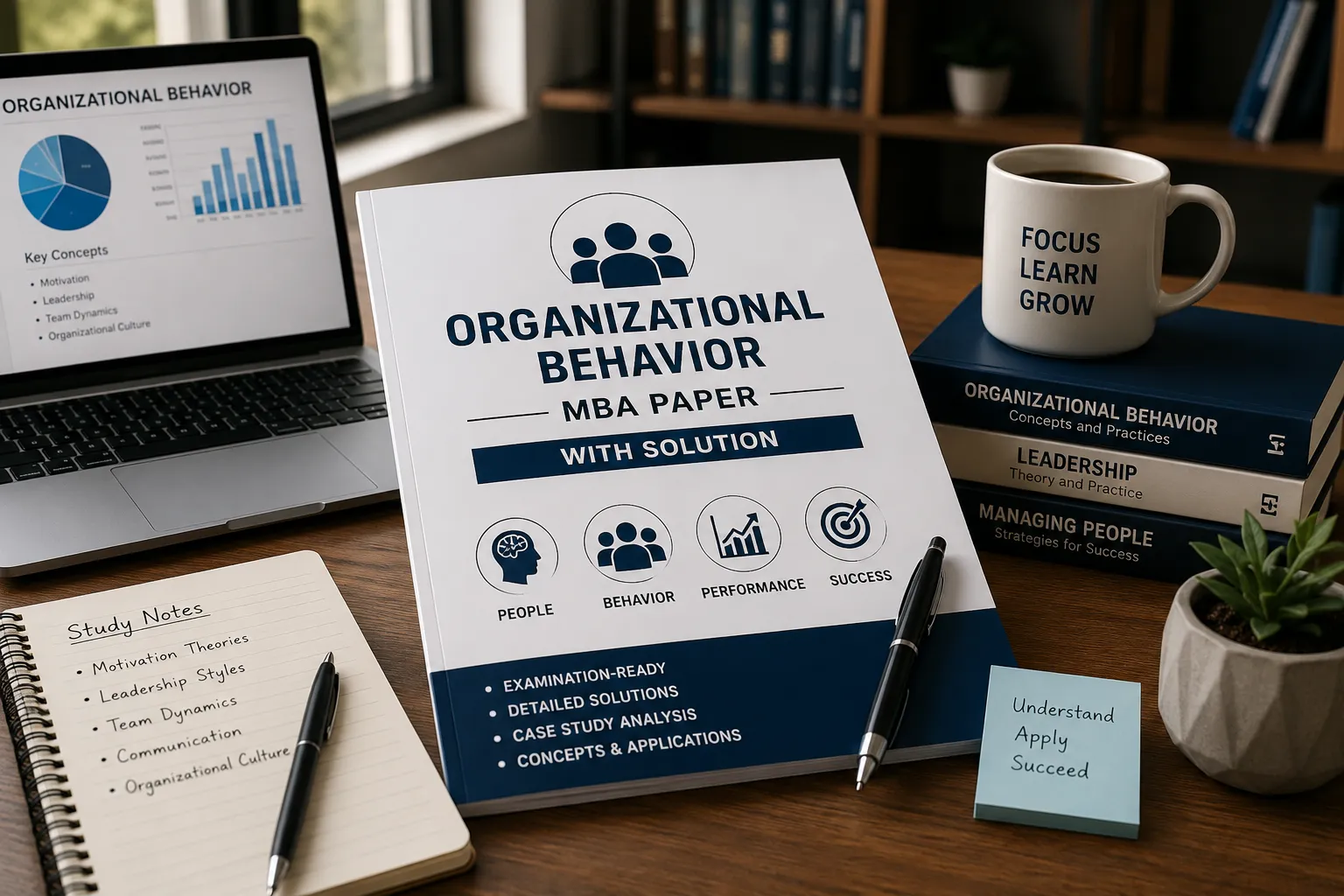
Moreover, organisational behaviour answers the question every manager eventually asks. Why do intelligent, well-paid people behave in ways that help — or quietly sabotage — the organisation that employs them? Moreover, this paper solution moves through the subject as examiners structure it. Furthermore, it covers what OB is, its levels of analysis, motivation, culture, and groups. Moreover, it also covers teams, leadership inside organisations, and change with its resistance. Furthermore, because OB is a diagnostic discipline, both worked examples are scored diagnoses. In addition, each one is a real management judgement, broken into numbers a student can follow and repeat.
What Organizational Behavior Actually Means
Therefore, organisational behaviour (OB) is the systematic study of how individuals and groups act within organisations. However, it also studies how organisations can structure and lead them. For example, it also studies how they motivate people so that behaviour supports organisational goals. Consequently, it borrows from psychology (perception, motivation, personality), sociology (groups, culture, power) and social psychology (attitudes, communication). It applies them to workplace questions: why is this team performing, why is that department resisting, why do good recruits leave?
For example, two distinctions earn marks. First, OB is descriptive and prescriptive: it explains behaviour. Its purpose is to change managerial practice — a theory that cannot alter a decision on Monday morning is unfinished. Second, OB is not the same as human resource management. Similarly, HRM designs the formal systems (pay structures, appraisal, recruitment). OB studies the human behaviour those systems produce — and frequently why the behaviour differs from what the system intended. Therefore, the two subjects are partners, and our Human Resource Management MBA paper covers the systems side.
The Key Elements and Levels of Organizational Behavior
Meanwhile, OB is organised at three levels of analysis. However, exam questions usually target one while rewarding answers that connect all three. In short, at the individual level: personality, perception, values, attitudes, learning and motivation — the raw material each person brings. Moreover, at the group level: team structure, norms, communication, leadership and conflict — where individual behaviour is amplified or corrected by others. At the organisational level: culture, structure and change — the context that shapes which individual and group behaviours are rewarded.
Consequently, the connecting insight is that problems rarely live at one level only. A “lazy employee” (individual framing) may be a person whose team norms punish effort (group level) inside a culture that never recognises good work (organisational level). Moreover, skilled diagnosis climbs the levels before prescribing; unskilled diagnosis blames the person nearest the problem. The elements also interact across time: structure shapes culture, culture shapes motivation, motivation shapes the results that justify the structure — a loop, not a list.
Motivation Theories: What They Explain
Similarly, motivation theories divide into content theories (what people want) and process theories (how wanting turns into effort). Furthermore, among content theories, Maslow’s hierarchy orders needs from physiological through safety, social, esteem to self-actualisation. Therefore, it implies managers must know which level is currently unsatisfied. In addition, Herzberg’s two-factor theory separates hygiene factors from motivators. Hygiene factors are pay, conditions, company policy, supervision, and security. Their absence causes dissatisfaction, but their presence merely prevents it. Motivators are achievement, recognition, the work itself, responsibility, and growth, which alone produce genuine effort. McClelland highlights needs for achievement, power and affiliation, unevenly distributed between people. Among process theories, expectancy theory holds that effort depends on three beliefs. They are that effort leads to performance, performance leads to reward, and the reward is valued. If any link is zero, motivation is zero. Equity theory adds that people compare their input–reward ratio with colleagues’ and restore fairness, sometimes by reducing effort, when they judge it unequal.
Worked Example 1: A Herzberg Diagnosis of a Warehouse Supervisor
In short, consider Daniel, a fictional warehouse supervisor at a fictional logistics firm, Northgate Distribution. His manager, suspecting low motivation, scores his job against Herzberg’s factors from interviews (1 = very poor, 5 = excellent):
| Hygiene factors | Score /5 | Motivators | Score /5 |
|---|---|---|---|
| Pay | 2 | Achievement | 2 |
| Working conditions | 3 | Recognition | 1 |
| Company policy and admin | 2 | The work itself | 3 |
| Supervision | 3 | Responsibility | 2 |
| Job security | 4 | Growth and advancement | 1 |
| Total / average | 14 / 2.8 | Total / average | 9 / 1.8 |
Read the diagnosis in Herzberg’s order. Moreover, hygiene averages 2.8 — below the neutral midpoint of 3 — pulled down by pay and policy. Daniel is actively dissatisfied; in that state, adding motivators would be wasted, because grievances drown them out. Motivators average only 1.8, with recognition and growth at the floor: even a contented Daniel would have little pulling him to excel. The prescription follows the sequence. First repair the two hygiene failures (review pay against market, fix the rota policy he complains about). Then rebuild motivators — public recognition of his team’s accuracy record, responsibility for the new shift pattern, and a visible promotion path. Furthermore, the framework’s contribution is ordering: hygiene first, motivators second, in that sequence or not at all.
Organizational Culture: What It Is and Its Types
Organisational culture is the shared values, assumptions and habits that tell members “how things are done here” — visible in rituals, stories, language, and what gets rewarded. It is powerful precisely because it operates without written rules. In addition, a widely used classification distinguishes four types. A clan culture is family-like: loyalty, mentoring and participation; it motivates through belonging. For example, a hierarchy culture prizes structure, procedures and reliability — typical of regulated industries where errors are expensive. A market culture is results-driven: competition, targets and winning define worth.
Therefore, an adhocracy culture values experimentation and speed, accepting failure as the price of innovation. Real organisations blend the four; the OB point is fit. However, a hierarchy culture running a creative studio will smother it. An adhocracy culture running a payroll bureau will eventually misplace someone’s salary. Consequently, culture also explains merger failures, where two functioning cultures discover their assumptions are incompatible. It is the soil in which the change efforts of Question 7 either root or wither.
How Groups Develop in Organizational Behavior — and Why It Matters
Similarly, groups are not teams on day one; they develop. Tuckman’s model describes four stages. Meanwhile, Forming: members are polite, uncertain and dependent on the leader. The group needs direction and clarity more than freedom. In short, Storming: roles and approaches are contested; conflict surfaces. Many groups stall here because the disagreement feels like failure rather than progress.
Norming: shared expectations settle — how meetings run, how disagreement is handled, what quality means — and cohesion builds. Moreover, Performing: the group finally spends its energy on the task, with roles fluid and trust doing the coordinating. (A fifth stage, adjourning, covers the group’s end.) Two managerial consequences follow. First, leadership must change by stage: directive in forming, coaching through storming, progressively hands-off as norms form. Second, group norms — the unwritten rules members enforce on each other — can support or cap performance regardless of individual talent. A team whose norm is “never outshine the slowest member” will defeat every incentive scheme aimed at individuals. Furthermore, conflict inside this process is managed with the approaches in our Negotiation and Conflict Resolution MBA paper.
Leadership Styles in Organizational Behavior: When They Work
OB treats leadership as behaviour in context, not as a personality gift. The classic spectrum runs from autocratic (the leader decides; fast and clear, appropriate in crises and with inexperienced teams, corrosive if permanent). It runs through democratic/participative (the leader decides with the group; slower, but buys commitment and better information — essential when the leader lacks the facts). Moreover, it ends at laissez-faire (the group decides; workable only with expert, self-managing professionals). In addition, contingency thinking adds the deciding principle: effectiveness depends on the match between style, followers and task.
A skilled team on a routine task needs little direction and much delegation. For example, the same team in a crisis needs one voice. Emotional and relational skills underpin all three styles — a leader who cannot read a room will misjudge which style the moment requires. The fuller treatment of leadership theory, including the change context, is in our Leadership and Change Management MBA paper. The communication skills leaders rely on are covered in our Business Communication MBA paper.
Why People Resist Change — and How to Manage It
Therefore, resistance to change is information, not insubordination. Its causes are predictable: threatened interests (pay, status, comfortable routines), misunderstanding of what the change involves, low trust in those proposing it, and genuine disagreement about whether the change will work. Managing it therefore starts with diagnosis, not pressure. The standard toolkit is participation (people support what they help to build) and honest communication about reasons. Support and training help where the barrier is skill, and negotiation helps where losses are real. Formal authority is the last resort. Timing matters as much as method: involving people after decisions are final converts consultation into theatre. Consequently, employees can tell the difference.
Worked Example 2: Scoring a Team’s Readiness for Change
Before announcing a new scheduling system, a fictional retail chain, Hartley’s Home Stores, scores its store teams on six readiness factors (1 = very weak, 5 = very strong). The interpretation bands are: 24–30 ready to proceed; 17–23 proceed with support work; 6–16 not ready — groundwork first.
| Readiness factor | Score /5 | Evidence |
|---|---|---|
| Communication so far | 2 | Staff heard of the change as a rumour |
| Visible leadership support | 4 | Store managers back the change openly |
| Resources and training planned | 3 | Training exists but is not yet scheduled |
| Past experience of change | 2 | The last system rollout was abandoned |
| Employee involvement in design | 2 | No store staff on the project group |
| Shared sense of urgency | 3 | Staff agree the old rota system is painful |
| Total | 16 / 30 | Band: not ready |
The score converts anxiety into a worklist. Similarly, the strengths (leadership support, genuine urgency) say the ground is fertile. The three 2s say exactly where the groundwork lies. Communicate officially before the rumour mill does more damage. Put two respected store staff on the project group. Acknowledge the abandoned rollout openly rather than pretending it built confidence. Hartley’s delayed launch by one month and spent it on those three items. Meanwhile, the exam lesson is the method: readiness is measurable before launch. A low score is a plan, not a verdict.
Case Study: Oak & Vine Furniture and the Helpful Norm
In short, Oak & Vine is a fictional furniture retailer created for this paper. Its delivery teams were famously cooperative — drivers routinely waited for each other. Moreover, shared difficult jobs — yet the firm kept missing delivery windows, and management blamed “attitude”. An OB reading found something subtler. Furthermore, the teams had developed a powerful norm: the crew returns together, whatever happens. It produced loyalty and mutual help (a genuine clan strength).
It also meant one delayed installation held three other crews idle, and new drivers who suggested splitting up were frozen out as “not team players”. In addition, the norm, not the people, was the problem. Management changed the norm rather than fighting it: crews kept shared start-of-day briefings. For example, mutual help, but return times were individualised. The first driver to model the new pattern was publicly thanked by the operations director. Missed windows fell within two months, and the cooperative culture survived intact — because the intervention respected what the norm was for (solidarity) while replacing what it did (waiting).
Organizational Behavior: Quick Answers
What is the difference between organisational behaviour and organisational culture?
Therefore, culture is one component inside OB — the shared values and habits of the organisation. OB is the wider field: it also covers individuals, motivation, groups, leadership, structure and change. However, culture is the component that most strongly connects the others, because it defines what behaviour gets rewarded.
Is money the strongest motivator at work?
Usually not beyond a point. Herzberg’s evidence treats pay mainly as a hygiene factor: too little actively demotivates, but increases beyond a fair level buy little extra effort compared with recognition, responsibility and growth. Consequently, pay must be right first — then motivators do the real work.
Why do teams pass through a storming stage instead of skipping it?
Because roles, standards and influence genuinely have to be negotiated, and that negotiation involves disagreement. Groups that appear to skip storming have usually suppressed it, and the unresolved issues return at the performing stage when deadlines make them expensive. Similarly, managed openly, storming is the cheapest time to surface them.
Is resistance to change always a problem to overcome?
No. Resisters sometimes hold information the planners lack — a flaw in the new process, a customer consequence nobody modelled. Meanwhile, treating resistance as feedback first, and obstruction only when proven, both improves the change and preserves trust.
Behaviour Is the Organisation, Seen From Inside
The habit that earns marks in this subject is disciplined diagnosis. Locate the behaviour, identify its level — individual, group, organisational — apply the framework that fits, and prescribe in the order the framework demands. Organisations do not have behaviour problems in the abstract; they have specific people, in specific groups, inside specific cultures. In short, answer at that level of precision and OB stops being common sense with citations and becomes a management skill.
6 thoughts on “Organizational Behavior MBA Paper with Solution”