A company can survive losing a product line. Losing its best people, repeatedly and without a plan for who steps in next, is a much harder problem to recover from. Talent management and succession planning exist precisely to prevent that kind of quiet, compounding damage, treating people development as a deliberate strategy rather than something handled reactively when a key employee suddenly resigns.
This paper covers the core questions MBA students face on talent management and succession planning. Each answer is structured, backed by real examples, and written the way you’d want to present it on an exam.
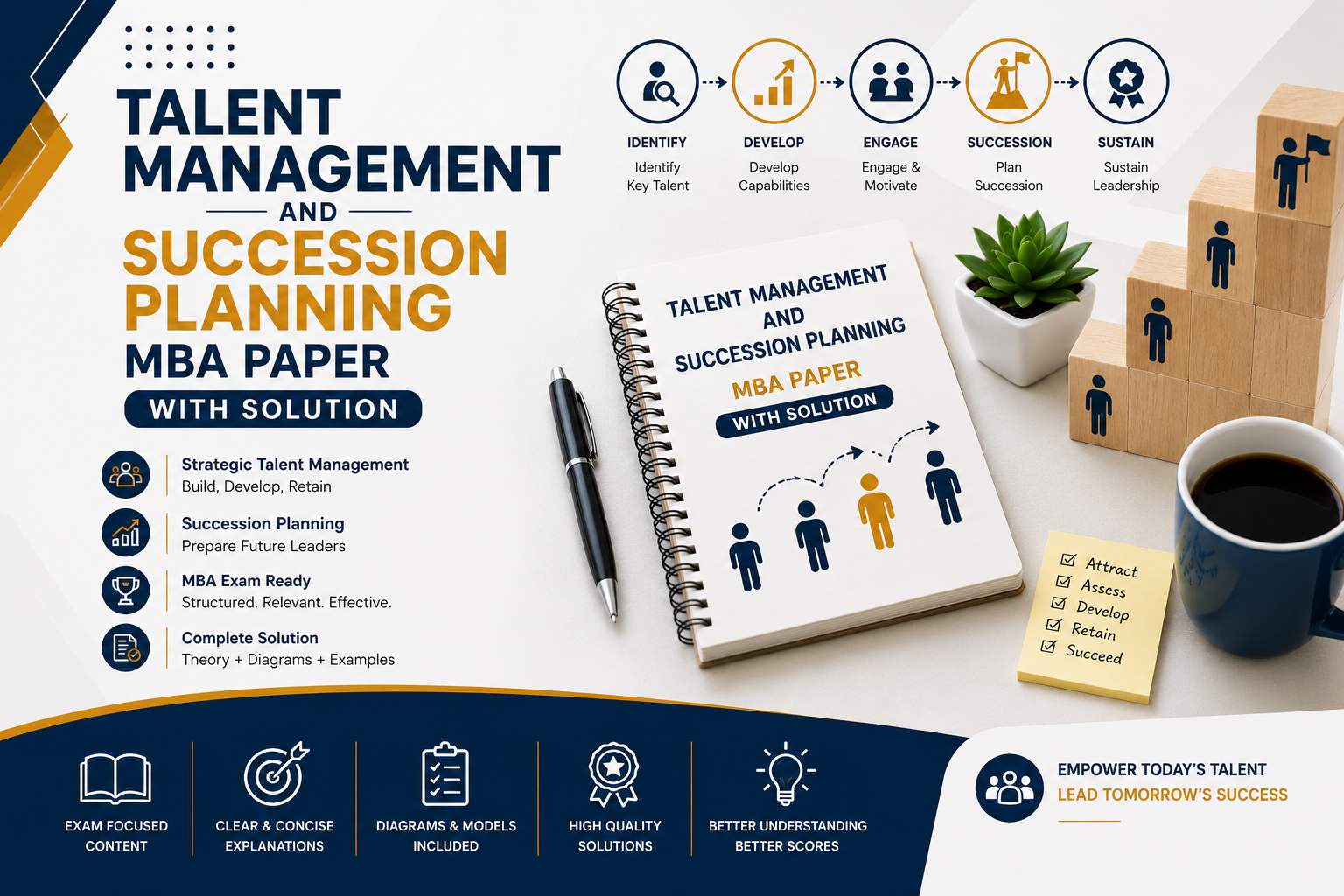
Talent Management and Succession Planning MBA Paper with Solution
Question 1: What Is Talent Management?
Talent management is the ongoing process of attracting, developing, motivating, and retaining skilled employees to meet an organization’s current and future needs. It extends well beyond traditional HR administration into a genuinely strategic function.
Talent management typically covers:
- Workforce planning and forecasting
- Recruitment and selection of high-potential employees
- Learning and development programs
- Performance management and career pathing
- Retention strategy
Unlike basic HR administration, talent management takes a forward-looking view, asking not just “do we have enough people today” but “do we have the right capabilities to meet where the business is heading.”
Question 2: Explain the Talent Management Lifecycle
Talent management generally follows a continuous cycle, rather than a single event tied to hiring.
Attraction involves building an employer brand and recruitment strategy that draws in the right candidates.
Onboarding involves integrating new employees effectively, setting the tone for their entire tenure with the company.
Development involves ongoing training, mentoring, and skill-building to help employees grow into future roles.
Engagement involves keeping employees motivated and connected to their work, since even highly skilled employees underperform when disengaged.
Retention involves proactively addressing the factors that cause valuable employees to leave, before they actually do.
Transition involves managing an employee’s eventual departure, whether through promotion, retirement, or resignation, in a way that protects organizational knowledge.
Treating any one stage in isolation tends to undermine the others. A company that invests heavily in attraction but neglects development often finds itself simply recruiting to replace the talent it fails to retain.
Question 3: What Is Succession Planning, and Why Does It Matter?
Succession planning is the process of identifying and developing internal employees with the potential to fill key leadership positions in the future, ensuring business continuity when current leaders eventually leave.
Succession planning matters because:
- Unplanned leadership departures can disrupt strategic continuity
- External hiring for senior roles is often costlier and riskier than internal promotion
- Employees are more likely to stay when they see a genuine path for advancement
- Institutional knowledge is preserved when transitions are planned rather than sudden
Companies without a succession plan often scramble when a key executive departs unexpectedly, sometimes making rushed hiring decisions under pressure that wouldn’t hold up under normal circumstances.
Question 4: Discuss the Nine-Box Grid Used in Talent Management
The nine-box grid is a widely used tool for evaluating employees along two dimensions: current performance and future potential. AIHR’s practitioner guide to the 9-box grid covers how to build and apply the tool in more detail.
The grid typically categorizes employees into segments such as:
- High performance, high potential — often considered future leaders, deserving significant development investment
- High performance, moderate potential — strong, reliable contributors who may not be suited for higher leadership roles
- Moderate performance, high potential — employees who may need additional support or a role better suited to their strengths
- Low performance, low potential — employees who may require performance improvement plans or reassignment
The grid isn’t meant to permanently label employees. Rather, it helps organizations allocate development resources thoughtfully, ensuring that investment in coaching, training, and stretch assignments goes where it’s likely to generate the greatest long-term return for both the employee and the business.
Question 5: What Are the Key Components of an Effective Succession Plan?
A genuinely effective succession plan involves more than simply identifying a backup name for each critical role.
Key components include:
- Identifying critical roles — determining which positions would create significant disruption if vacated unexpectedly
- Assessing potential successors — evaluating internal candidates against the skills and experience the role requires
- Development planning — providing targeted training, mentoring, or stretch assignments to close identified gaps
- Knowledge transfer — ensuring institutional knowledge doesn’t leave with a departing leader
- Regular review — updating the plan as business needs, roles, and available talent evolve over time
A common mistake is treating succession planning as a one-time exercise, documented once and left untouched. Roles, business priorities, and available talent all shift, meaning a succession plan needs periodic revisiting to stay genuinely useful.
Question 6: How Does Talent Management Support Employee Engagement and Retention?
Retention and engagement aren’t separate from talent management. They’re often the direct result of how well it’s executed.
Talent management supports retention through:
- Clear career pathways — employees who can see a genuine future with the company are less likely to look elsewhere
- Meaningful development opportunities — investment in growth signals that the company values an employee’s long-term contribution
- Fair and transparent performance evaluation — employees who trust the evaluation process tend to feel more genuinely invested
- Recognition and reward — acknowledging contributions reinforces motivation beyond compensation alone
This connects closely to the motivation theories covered in our Organizational Behavior MBA paper, since effective talent management often applies the same underlying psychological principles — recognition, autonomy, growth — that drive employee motivation more broadly.
Question 7: What Role Does Leadership Development Play in Succession Planning?
Leadership development programs prepare high-potential employees for future leadership roles, forming a critical bridge between identifying successors and actually having them ready when a transition occurs.
Common leadership development approaches include:
- Formal training programs — structured courses covering strategic thinking, financial acumen, and people management
- Mentoring and coaching — pairing high-potential employees with experienced leaders for guided development
- Stretch assignments — giving employees responsibility beyond their current role to build relevant experience
- Cross-functional rotations — exposing future leaders to different parts of the business before they take on broader leadership responsibility
Simply identifying a successor isn’t enough if that person isn’t genuinely prepared when the transition actually happens. Leadership development closes that gap, turning a name on a succession chart into someone actually ready to step into the role.
Why Talent Management and Succession Planning Matter in MBA Programs
Nearly every organization depends on having the right people in the right roles, making this subject relevant across virtually every management career path, not just HR specifically.
Studying talent management and succession planning helps students:
- Understand how to build a sustainable pipeline of future leadership talent
- Learn to evaluate and develop employee potential systematically
- Build skills in workforce planning tied to broader business strategy
- Prepare for leadership roles requiring genuine people development capability
- Appreciate how retention and succession planning protect long-term organizational stability
A Practical Example: Building a Succession Plan Under Pressure
Consider a mid-sized manufacturing company whose long-serving operations director announces retirement, effective in eight months. Historically, the company had no formal succession plan, and leadership initially considers an external search as the default approach.
Before committing to external hiring, HR conducts a quick internal talent review using a nine-box-style assessment. Two internal candidates emerge as strong potential fits, both showing high performance and considerable leadership potential, though each has specific skill gaps relative to the role’s full scope.
Rather than choosing purely based on tenure, the company invests the available eight months in targeted development. One candidate shadows the departing director directly on budget and vendor negotiations, an area of relative weakness. The other takes on a temporary cross-functional project specifically to build broader operational visibility beyond their current department.
When the transition date arrives, one of the two internal candidates is promoted into the role, having spent eight months closing the specific gaps the assessment identified. The transition proceeds smoothly, preserving institutional knowledge that an external hire would have taken considerably longer to rebuild. This example illustrates why succession planning works best as an ongoing practice rather than a reactive scramble — but even a late start, handled deliberately, produces a far better outcome than no plan at all.
Common Challenges in Talent Management and Succession Planning
Overreliance on a Single Successor
Identifying only one candidate per critical role creates fragility if that person also leaves or isn’t ready when the transition actually occurs.
Bias in Potential Assessment
Evaluations of “potential” can be influenced by unconscious bias, sometimes overlooking strong candidates who don’t fit a narrow, traditional leadership profile.
Insufficient Investment in Development
Identifying high-potential employees means little without genuine investment in the training and experience needed to prepare them for larger roles.
Lack of Organizational Buy-In
Succession planning requires consistent commitment from senior leadership. Without it, plans are often created once and then quietly neglected.
Tips to Write Strong Talent Management and Succession Planning MBA Answers
Use Real Organizational Scenarios
Referencing realistic succession or talent development situations shows applied understanding, not just abstract HR theory.
Distinguish Between Performance and Potential
Strong answers clearly separate current performance from future potential, since conflating the two is a common and consequential mistake in talent assessment.
Reference Structured Frameworks
Bringing in tools like the nine-box grid gives an answer clear structure and academic grounding.
Address the Human Side, Not Just Process
Strong answers acknowledge that succession planning affects real careers and relationships, not just organizational charts, and should be handled with genuine care.
FAQs
What is the difference between talent management and succession planning?
Talent management covers the full employee lifecycle, from attraction through retention, while succession planning specifically focuses on preparing internal candidates for future critical leadership roles.
Why is the nine-box grid a useful tool in talent management?
It helps organizations evaluate employees on both current performance and future potential together, guiding where development investment is likely to have the greatest impact.
What happens when a company has no succession plan for a critical role?
Unexpected departures can disrupt strategic continuity, often forcing rushed external hiring decisions or leaving important institutional knowledge without a clear path to preservation.
How does leadership development connect to succession planning?
It prepares identified successors with the specific skills and experience needed to genuinely succeed in a future role, rather than simply naming someone without adequate preparation.
Is succession planning only relevant for large corporations?
No. Even small and mid-sized businesses benefit significantly from succession planning, since the sudden loss of a key employee can be especially disruptive in a smaller organization with less redundancy.
Final Verdict
Talent management and succession planning give MBA students the tools to think beyond immediate staffing needs and toward the long-term sustainability of an organization’s leadership pipeline. Companies that treat people development as a deliberate, ongoing strategy tend to weather leadership transitions far more smoothly than those that scramble reactively when a key person unexpectedly leaves. Students who understand both subjects carry a genuine advantage, since building and sustaining strong talent is ultimately what allows any strategy to actually be executed over the long term.