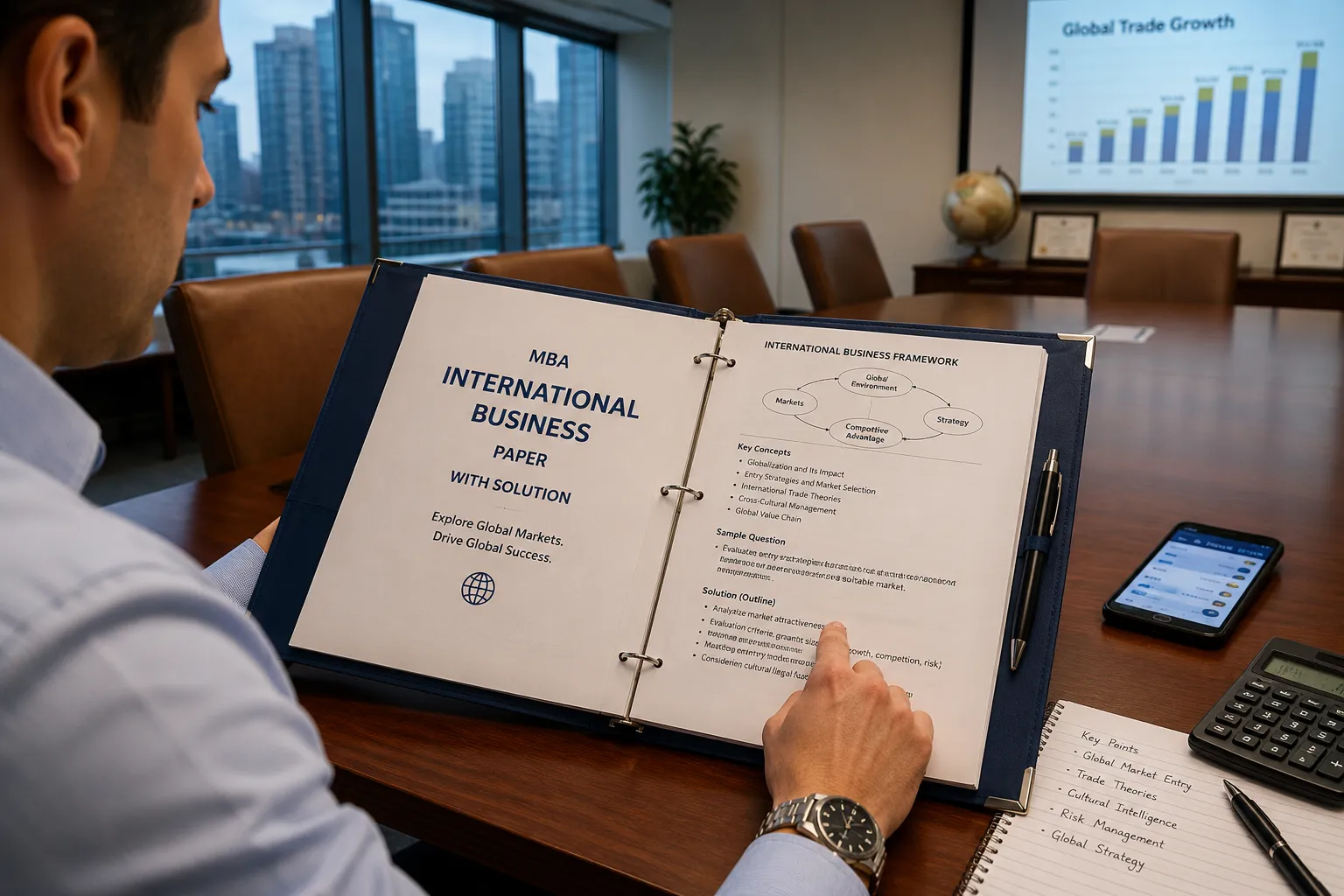
Moreover, the moment a business crosses a border, every familiar decision acquires new variables. Furthermore, they include a second currency, a second legal system and a second culture. Moreover, international business is the study of those decisions — why countries trade, how firms enter foreign markets. In addition, the paper also shows what exchange rates and tariffs do to the numbers. For example, this paper solution works through trade theory, entry modes, globalisation and culture. Therefore, it includes three calculations in full. However, they cover comparative advantage in labour hours and an exchange-rate swing traced through an export price. Consequently, it also covers a tariff built into a landed cost.
Question 1: What Is International Business?
Similarly, international business covers all commercial activity that crosses national borders: exporting and importing goods. In addition, it covers services, licensing, franchising, foreign direct investment, and the management of operations in more than one country. Meanwhile, it differs from domestic business not in kind but in complexity. In short, every familiar variable (customers, law, money, logistics) behaves differently abroad. Moreover, each new country adds its own currency, regulations, culture and political risk.
For example, a useful exam distinction: international trade is the cross-border exchange of goods and services. Moreover, international business is the wider field, including owning and running operations overseas. Therefore, a firm exporting through an agent trades internationally. In addition, a firm with its own factory abroad is in international business in the full sense.
Question 2: What Are the Key Theories of International Trade?
However, three theories carry most exam papers. For example, Absolute advantage (Adam Smith) is simple. Therefore, countries gain by specialising where they are more efficient than everyone else and trading for the rest. Comparative advantage (David Ricardo) goes further and is the genuinely important one: even a country that is worse at producing everything still gains by specialising where its disadvantage is smallest. However, Heckscher–Ohlin explains the pattern by endowments. Consequently, countries export goods that use their abundant factors. Furthermore, labour-abundant countries export labour-intensive goods, and capital-abundant countries export capital-intensive ones.
Worked Example 1: Comparative Advantage in Labour Hours
In addition, the theory turns on opportunity cost, so compute it. Consequently, suppose producing one unit of textiles takes 4 labour hours in Country X and 6 in Country Y. One unit of electronics takes 8 hours in X and 9 in Y. Similarly, Country X is more efficient at both — it has absolute advantage in everything. Opportunity costs:
| Country X | Country Y | |
|---|---|---|
| Opportunity cost of 1 unit of textiles | 4 ÷ 8 = 0.5 units of electronics | 6 ÷ 9 = 0.67 units of electronics |
| Opportunity cost of 1 unit of electronics | 8 ÷ 4 = 2.0 units of textiles | 9 ÷ 6 = 1.5 units of textiles |
Meanwhile, textiles cost less, in forgone electronics, in X (0.5 < 0.67), so X holds the comparative advantage in textiles. Electronics cost less in Y (1.5 < 2.0 textiles), so Y holds it there — despite being slower at both. If X specialises in textiles and Y in electronics and they trade, both consume more than either could alone. That single computation is the intellectual foundation of world trade, and the reason trade barriers in Question 7 carry a real cost.
Question 3: What Modes of Entry Into Foreign Markets Are Available?
In short, entry modes form a ladder of rising investment, control and risk:
- Exporting: produce at home, sell abroad, directly or through agents. Lowest risk, least control over marketing and price.
- Licensing: a foreign firm pays to use your intellectual property. Cheap and fast, but the licensee may become tomorrow’s competitor.
- Franchising: the license logic extended to a whole business format, common in food and retail services.
- Strategic alliances and joint ventures: share ownership and risk with a local partner who contributes market knowledge, licences and networks.
- Wholly owned subsidiary: build (greenfield) or buy (acquisition) your own operation. Maximum control, maximum exposure.
The choice depends on the firm’s resources, the product’s sensitivity to control, and the market’s risk. This is the same external analysis discipline applied in our Strategic Management MBA paper. Most firms climb the ladder gradually, exporting first and investing only when the market has proved itself.
Question 4: How Has Globalisation Shaped International Business?
Moreover, globalisation is the deepening integration of markets, production and finance across borders. It is driven by falling transport and communication costs, trade liberalisation and digital platforms. Furthermore, for business it has meant global supply chains. Components cross several borders before assembly, as mapped in our Supply Chain Management MBA paper. It has also meant global brands selling near-identical products everywhere, and competition arriving from anywhere. A start-up’s rival may be on another continent.
A balanced answer includes the counter-currents: supply shocks and geopolitics pushing firms toward regionalisation and “friend-shoring”, and consumer and political pressure over jobs, culture and the environment. In addition, examiners reward candidates who present globalisation as a powerful but neither automatic nor irreversible trend.
One driver deserves separate mention because it changed who can participate: digital platforms. A small firm can now sell through global marketplaces. It can advertise into foreign markets for a few pounds a day. It can be paid through international payment services. These capabilities required subsidiaries, agents and bank relationships two decades ago. Globalisation’s first wave belonged to multinationals; its current wave is open to almost any firm with a product that travels and the patience to learn a market.
Question 5: What Is Foreign Exchange Risk, and How Does It Bite?
Foreign exchange risk is the possibility that currency movements change the home-currency value of foreign earnings, costs or prices between the moment a deal is agreed and the moment it is settled. For example, exporters typically invoice weeks or months before payment, so the rate that matters is the future one, not today’s.
Worked Example 2: An Exchange-Rate Movement Changes Export Economics
A British manufacturer exports a machine priced at £4,000 to the eurozone, when £1 = €1.15. Therefore, the European list price is £4,000 × 1.15 = €4,600. Sterling then strengthens to £1 = €1.25. However, trace both of the exporter’s options:
| Option | Calculation | Result |
|---|---|---|
| Keep the £4,000 price | £4,000 × 1.25 | Euro price rises to €5,000 (+€400, +8.7%) — sales volume at risk |
| Hold the €4,600 price | €4,600 ÷ 1.25 | £ revenue falls to £3,680 — £320 less per machine (−8.0%) |
Either way, an 8–9% swing lands on competitiveness or on margin, without the firm changing anything it controls. Firms manage this with forward contracts (locking a future rate). They can invoice in their home currency (passing the risk to the buyer). They can match foreign costs to foreign revenues, or simply build a margin cushion into export prices. The exam point is that the risk is quantifiable and manageable — ignoring it is the only indefensible option.
Question 6: How Do Cultural Differences Affect International Business?
Similarly, culture shapes what customers value, how negotiations proceed, what motivates employees and what counts as polite, urgent or rude. Frameworks such as Hofstede’s dimensions — individualism versus collectivism, power distance, uncertainty avoidance, long-term orientation — give managers a vocabulary for these differences: a direct, deadline-driven pitch that works in one market can read as aggressive in a high-context culture where relationships precede business.
Failure patterns are consistent: advertising translated literally but not culturally, incentive schemes that reward individual stars in collectivist teams, and expatriate managers applying home-office rules untouched. The remedy is local input early — local partners, local hires, and adaptation of the offer. This is the subject of our International Marketing MBA paper and the deeper treatment in our Cross-Cultural Management MBA paper. Meanwhile, standardise what the customer does not see; adapt what the customer experiences.
Question 7: What Are Trade Barriers, and What Do They Do to a Business?
Trade barriers are government measures that restrict or tax cross-border trade. In short, Tariffs are taxes on imports, charged as a percentage of value or per unit. Quotas cap quantities. Moreover, Non-tariff barriers — licensing rules, technical standards, local-content requirements, customs delays — restrict without an explicit tax. Governments impose them to protect domestic industries and jobs, raise revenue, or pursue strategic goals. Their cost falls on consumers (higher prices), exporters (lost margin or market), and the economy (the comparative-advantage gains of Question 2 forgone).
Worked Example 3: A Tariff Flows Into Landed Cost and Margin
Furthermore, an importer buys a product abroad for $80 per unit and pays $10 shipping and insurance. This gives a customs value of $90. In addition, the importing country charges a 15% tariff on that value. Build the landed cost step by step:
| Element | Calculation | Amount |
|---|---|---|
| Product cost | Given | $80.00 |
| Shipping and insurance | Given | $10.00 |
| Customs value | $80 + $10 | $90.00 |
| Tariff at 15% | 15% × $90 | $13.50 |
| Landed cost | $90 + $13.50 | $103.50 |
For example, now the business consequence. The importer sells at $140. Therefore, without the tariff, gross margin would be $140 − $90 = $50 (35.7% of price). With it, margin falls to $140 − $103.50 = $36.50 (26.1%). However, the tariff consumed $13.50 — more than a quarter of the original margin. The importer must now choose: absorb it, raise the price and risk volume, renegotiate the purchase price, or source from a country with a trade agreement. That four-way choice, repeated across thousands of products, is how trade policy becomes a business decision.
Case in Point: ProKick Sports Enters Germany One Step at a Time
ProKick Sports, a fictional sports-goods maker, sold its footballs successfully at home and received enquiries from a German sports retailer. Consequently, rather than opening a European office, the owners climbed the entry ladder deliberately. Year one: direct exporting of a small range, invoiced in euros but with prices reviewed quarterly after an early lesson in exchange-rate movement of exactly the kind worked in Example 2. Year two: an exclusive distribution agreement, after the retailer’s sell-through data showed which sizes.
Similarly, it showed which price points the German market actually wanted. This was market knowledge no survey had supplied. Only in year four, with German sales a stable share of revenue, did ProKick consider a small local warehouse, and it chose a logistics partner rather than buying premises. Each step was bought with evidence from the step before. The firm’s maximum loss at any point was one season’s shipment — the international version of the staged-commitment logic that runs through this whole subject.
Frequently Asked Questions
What is the difference between a tariff and a quota?
Meanwhile, a tariff taxes imports, raising their price while letting quantity adjust — and generating government revenue. A quota caps the quantity directly, whatever buyers would pay. In short, both raise domestic prices; quotas are the blunter instrument because supply cannot respond at all.
Why would a firm choose a joint venture over its own subsidiary?
When local knowledge, licences or relationships are decisive and hard to buy, a partner supplies them immediately, and shares the investment risk. The price is shared control and shared profit — worth paying in high-risk or heavily regulated markets, less so where the firm already understands the ground.
Can small firms really trade internationally?
Yes — digital platforms, freight forwarders and export agents have collapsed the fixed costs that once restricted exporting to large firms. The constraints that remain are the same ones this paper covers: pricing through currency swings, meeting foreign standards, and adapting to the customer. Scale helps; it is no longer a prerequisite.
What is the simplest protection against exchange-rate risk?
Moreover, a forward contract: agreeing today the rate at which a known future receipt will be converted. It removes the uncertainty — both the loss and any gain — for a small cost. Furthermore, this is why it suits the predictable, invoice-based exposures exporters actually face.
International Business: Same Decisions, More Variables
Nothing in this subject is a different kind of management. It is the same pricing, sourcing, marketing and investment decisions made under extra layers of currency, culture, law and distance. The candidates who score well are those who quantify what can be quantified — an opportunity cost, an exchange swing, a landed cost . In addition, judge the human and political variables with equal care.
2 thoughts on “International Business MBA Paper with Solution”