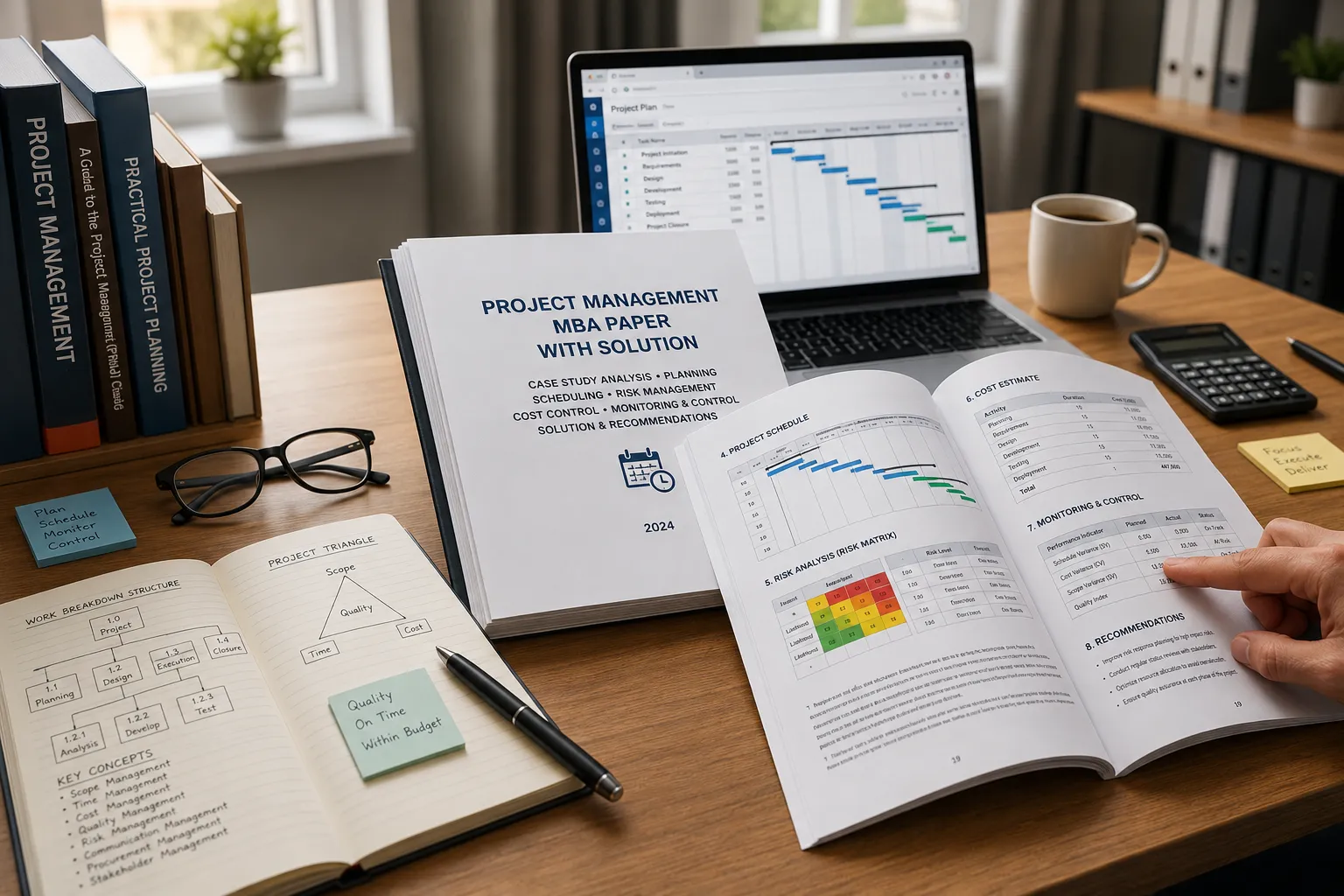
Moreover, every organisation runs two kinds of work: operations that repeat daily, and projects that happen once to change something. In addition, projects fail at striking rates in every industry — rarely on the tasks themselves. Furthermore, they fail on unclear scope, fantasy schedules and costs nobody tracked until the money was gone. For example, this paper solution covers the standard ground. Therefore, it covers what project management is, the life cycle, the methodologies, the project triangle, and the work breakdown structure. However, project risk is covered too, with the two control calculations, critical path and earned value, worked in full.
Question 1: What Is Project Management?
In addition, a project is a temporary endeavour with a defined start and finish. Moreover, it is undertaken to create a unique product, service or result. Project management is the application of knowledge, skills, tools and techniques to deliver that result within agreed scope, time and cost. For example, three words in the definition carry the marks. Similarly, Temporary separates a project from operations. Building a warehouse is a project; running the warehouse is operations, and confusing the two is a common root of failure. Therefore, Unique means the output has never been made in exactly this form before. Meanwhile, this is why uncertainty attaches to every estimate. Agreed means success is judged against objectives set with stakeholders at the start, not against whatever the team later finds convenient. The day-to-day discipline of the delivery side connects closely with the operations function examined in our Operations Management MBA paper.
Question 2: What Are the Phases of the Project Life Cycle?
However, most frameworks describe four or five phases. In short, Initiation defines the problem or opportunity. Moreover, it tests whether it is worth doing at all (the business case), names stakeholders, and appoints the project manager. Furthermore, its output is a charter authorising the work. Planning converts the intention into a workable scheme: scope, work breakdown structure, schedule, budget, quality standards, communication and risk plans. Consequently, planning is where projects are won quietly — hours here save weeks later. In addition, Execution is the doing: coordinating people and suppliers, managing quality and keeping stakeholders informed. Similarly, it normally consumes most of the budget. Alongside execution, monitoring and control compares actual progress with the plan and corrects deviations — earned value (Question 7) belongs here. For example, Closing hands over the deliverable, obtains formal acceptance, pays final accounts, releases the team and records lessons learned. Meanwhile, skipping it is why organisations repeat the same mistakes for decades.
Question 3: How Do the Main Project Management Methodologies Differ?
Therefore, the classic approach is Waterfall. Its phases run in sequence — requirements, design, build, test, deliver — with each stage signed off before the next begins. It suits projects whose output can be fully specified in advance and where late change is expensive: construction, manufacturing plant, regulated installations. However, its weakness is the mirror of its strength. Consequently, if the customer’s real need differs from the early specification, the error surfaces late, when correction costs most.
Similarly, Agile methods invert the logic. In short, work proceeds in short iterations (sprints), each delivering a usable piece of the product, with requirements reprioritised between iterations. Agile suits software and product development, where needs evolve and early feedback is worth more than a perfect initial plan. Meanwhile, its risks are the opposite ones: scope that never freezes and budgets that are hard to fix. Moreover, many organisations run a hybrid — waterfall governance around an agile build, for example. In short, the exam-grade way to choose is one question: how clearly can the end result be described before work starts?
Question 4: What Is the Project Management Triangle?
Moreover, the triangle (or triple constraint) holds that every project is governed by three linked constraints. They are scope (what will be delivered), time (by when) and cost (for how much), with quality sitting in the middle, affected by all three. Furthermore, the constraints are connected, so changing one disturbs at least one other. In addition, increase the scope, and either the deadline moves, the budget rises, or quality is quietly traded away. For example, a client who demands more features, on the same date, for the same money is not describing a plan. Therefore, they are describing a quality cut they have not admitted to.
In addition, the triangle’s exam value is diagnostic. However, when a project is in trouble, the skilled manager asks which corner the sponsor is genuinely willing to move. For example, that trade-off is made explicit and agreed, rather than happening silently as exhausted staff and untested work. Therefore, the triangle is why “faster, cheaper, better — pick two” survives as a saying.
Question 5: What Is a Work Breakdown Structure?
A work breakdown structure (WBS) is a hierarchical decomposition of the project’s total scope into smaller, manageable pieces called work packages. For example, it starts with the final deliverable and divides it by components or phases. However, a warehouse fit-out becomes site works, racking, systems, and commissioning. Each of those divides again until each package is small enough to be owned, estimated, scheduled and costed by one person.
Therefore, three rules give the WBS its power. The 100 percent rule: the children of any element must together cover all of its work and nothing beyond it. That way, nothing is double-counted and nothing is forgotten. The WBS lists deliverables, not activities — nouns before verbs; the schedule (Question 6) is built afterwards from these packages. The WBS is the single foundation for the estimates, the network diagram, the budget and later the earned value measurement. If work is not in the WBS, it is not in the project, and discovering it mid-project is how scope creep enters. Cost estimation built this way mirrors the bottom-up budgeting discipline in our Financial Management MBA paper.
Question 6: How Is the Critical Path Calculated?
Worked Example 1: Critical Path for a Packaging-Line Upgrade
However, Kestrel Foods, a fictional food manufacturer, is upgrading a packaging line. Its planners list six activities. The rule is simple: project duration equals the longest chain of dependent activities — the critical path. Any delay on it delays the whole project.
| Activity | Duration (weeks) | Depends on |
|---|---|---|
| A — Strip out old line | 4 | — |
| B — Electrical rewiring | 3 | A |
| C — Install new conveyor | 5 | A |
| D — Control panel fitting | 2 | B |
| E — Sensor and safety system | 6 | C |
| F — Testing and commissioning | 3 | D and E |
Consequently, now add up every complete path through the network:
- Path A → B → D → F = 4 + 3 + 2 + 3 = 12 weeks
- Path A → C → E → F = 4 + 5 + 6 + 3 = 18 weeks
The critical path is A → C → E → F, at 18 weeks — that is the earliest the upgrade can finish. The other path carries six weeks of float. Similarly, B, D’s chain could slip by up to six weeks before it delayed completion. This tells Kestrel where supervision belongs. The conveyor and sensor work get the experienced engineers and daily checks, while the rewiring chain can absorb a problem. It also prices acceleration honestly. Shortening the project means shortening C or E (crashing the critical path). Money spent speeding up B achieves nothing.
Question 7: How Does Earned Value Analysis Control a Project?
Worked Example 2: Earned Value on the Same Project, Week 10
Meanwhile, earned value compares three figures. Planned Value (PV) is the budgeted cost of work that should be done by now. Earned Value (EV) is the budgeted cost of work actually done. And Actual Cost (AC) is what that work really cost. The formulas come first:
- Cost Variance: CV = EV − AC (negative = over budget)
- Schedule Variance: SV = EV − PV (negative = behind schedule)
- Cost Performance Index: CPI = EV ÷ AC; Schedule Performance Index: SPI = EV ÷ PV (below 1 = poor)
- Estimate at Completion: EAC = BAC ÷ CPI, where BAC is the total budget
At week 10 on Kestrel’s upgrade (total budget BAC = $400,000): PV = $180,000, EV = $150,000, AC = $165,000.
| Measure | Calculation | Result | Meaning |
|---|---|---|---|
| Cost variance | 150,000 − 165,000 | −$15,000 | Over budget |
| Schedule variance | 150,000 − 180,000 | −$30,000 | Behind schedule |
| CPI | 150,000 ÷ 165,000 | 0.91 | Each $1 spent earns $0.91 of value |
| SPI | 150,000 ÷ 180,000 | 0.83 | Progressing at 83% of the planned rate |
| Percentage complete | 150,000 ÷ 400,000 | 37.5% | Against 45% planned |
| Estimate at completion | 400,000 ÷ (150,000 ÷ 165,000) | $440,000 | $40,000 over budget if nothing changes |
Moreover, the power of the method is that it says all this at week 10, while correction is still cheap. A manager relying on “we have spent $165,000 of $400,000” alone would not even know whether that was good or bad news. Earned value turns progress reporting from opinion into arithmetic.
Question 8: How Is Risk Managed Inside a Project?
Furthermore, project risk management follows the same rhythm as the general discipline. Identify risks early (supplier failure, key staff leaving, specification change, weather, technical unknowns). Assess each risk by probability and impact, then choose a response. Avoid it by changing the plan, reduce it by testing or dual-sourcing, transfer it by contract or insurance, or accept it with a contingency reserve. The risks and their owners are recorded in a risk register that is reviewed at every progress meeting, not filed at initiation and forgotten. In addition, two points earn marks: contingency belongs to identified risks, released by decision, never absorbed silently into estimates. The greatest project risks are usually visible at the start — the register written honestly in week one is the cheapest risk tool there is. The wider risk framework behind this question is developed in our Risk Management and Insurance MBA paper.
Question 9: What Does a Project Manager Do?
For example, the project manager is the single point of accountability for delivering the agreed result. The role integrates rather than executes. It builds the plan from specialists’ estimates, and sequences and resources the work. Moreover, it controls change (every scope request priced against the triangle before acceptance) and communicates honestly with stakeholders. It manages the risk register and reports progress truthfully — bad news early, especially. Technical brilliance is not the core requirement; the core is integration and honesty about trade-offs. A project manager who reports “all green” until the week the project fails has performed the opposite of the role. Therefore, the role ends with handover of a working deliverable — and of the lessons learned.
Case in Point: Kestrel Foods Rescues Its Upgrade
The earned value figures in Question 7 were Kestrel Foods’ wake-up call. The week-10 review showed the sensor and safety system (activity E, on the critical path) slipping because the supplier’s engineers were double-booked. Money was quietly leaking into overtime on the non-critical rewiring. Because the critical path analysis had already shown where float existed, the response was precise rather than panicked. Two electricians moved from the rewiring chain — which held six weeks of float — onto conveyor preparation. The supplier contract was renegotiated with a completion bonus tied to the E milestone. The sponsor agreed to fund $18,000 of the forecast $40,000 overrun from contingency to protect the commissioning date a retailer contract depended on.
The upgrade finished in week 19, one week late instead of the six the trend implied, and within the revised budget. However, Kestrel’s lesson is this paper’s lesson. The plan’s numbers are not bureaucracy — they are how a project tells you the truth while there is still time to act on it.
Frequently Asked Questions
What is float, and why does it matter?
Float is the amount of time an activity can slip before it delays the project’s finish. Consequently, activities on the critical path have zero float. It matters because it tells the manager where delay is dangerous (critical work) and where it is absorbable.
Can a project be behind schedule but under budget?
Similarly, yes — earned value shows this as a negative schedule variance with a positive cost variance. It usually means work is simply happening more slowly than planned, so less has been spent. Meanwhile, that is why spend alone never measures progress: the two variances must always be read together.
What is scope creep, and how is it controlled?
Scope creep is the uncontrolled addition of work after the plan is agreed. In short, a feature here, a small change there — each reasonable alone, together fatal. Control it with a change process. Price every addition against time and cost using the triangle, approve or reject it explicitly, and add it to the WBS only when approved.
When should a firm choose Agile over Waterfall?
Use Agile when the end result cannot be fully described in advance and the customer’s needs will evolve as they see working output. That is typical of software and new product development. When the output is specifiable and late change is very costly, as in construction, a predictive Waterfall approach remains the safer choice.
Project Management Is a Promise-Keeping System
A project is a promise: this result, by this date, for this much. The life cycle structures the promise, the WBS defines it, and the critical path dates it. Earned value reports whether it is being kept — in numbers nobody has to take on trust. Furthermore, learn to work those numbers and to speak about trade-offs before they choose you. You have learned the subject examiners are really testing.
1 thought on “Project Management MBA Paper with Solution”