A product designed in California, manufactured in Vietnam, financed through a bank in Singapore, and sold to a customer in Germany — that’s not a hypothetical anymore, it’s just Tuesday for a lot of companies. International business is the subject that explains how all of that actually works, and why it’s a lot messier than it sounds on paper.
This paper covers the core questions MBA students typically face on international business, answered the way you’d want to present them on an exam — structured, grounded in real examples, and without unnecessary padding.
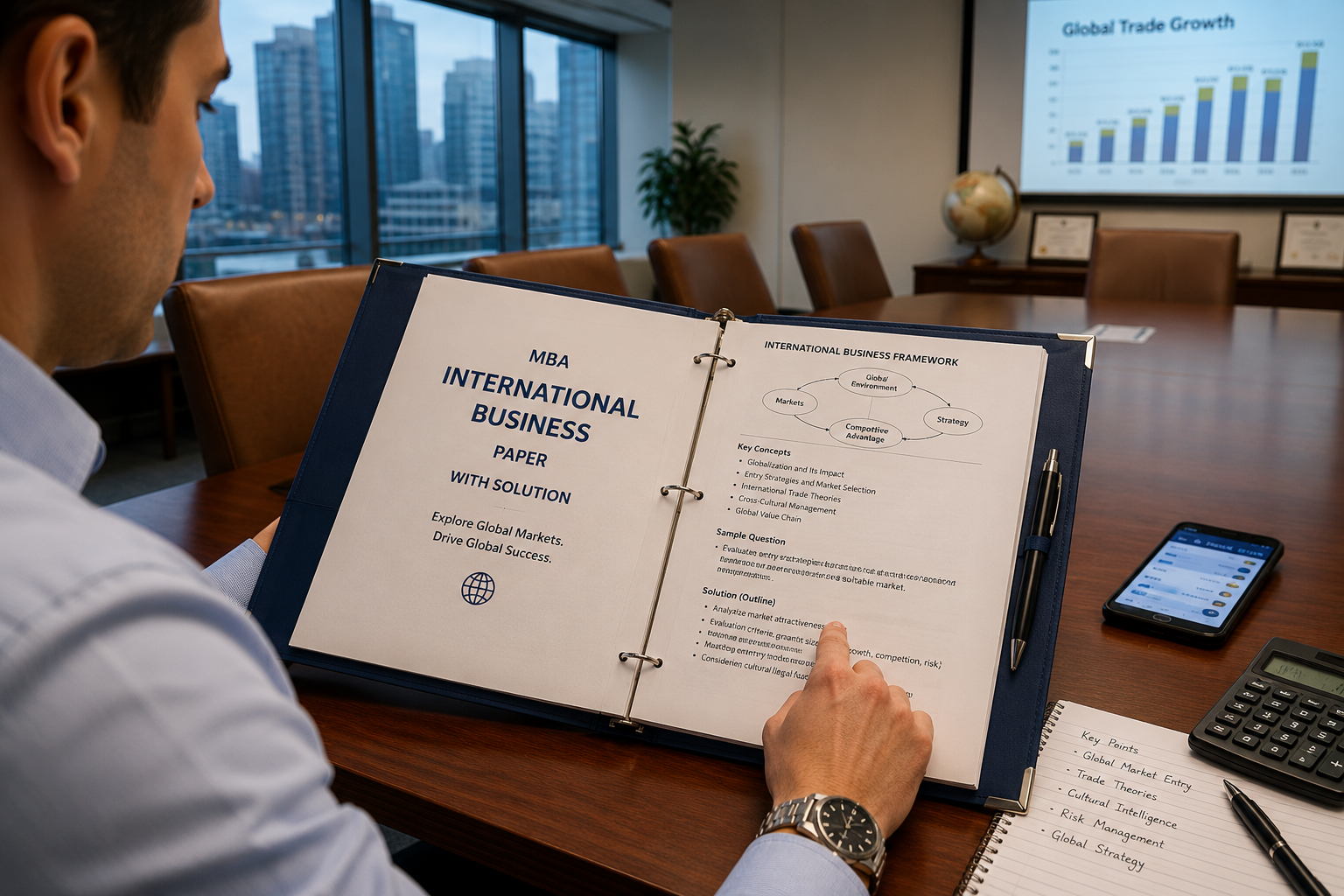
International Business MBA Paper with Solution
Question 1: What Is International Business?
International business refers to any commercial activity that crosses national borders — trade, investment, manufacturing, or services conducted between businesses and customers in different countries. It covers everything from a small exporter selling handmade goods abroad to a multinational corporation running factories on three continents.
International business typically involves:
- Import and export trade
- Foreign direct investment
- International licensing and franchising
- Global supply chain management
- Cross-border joint ventures and partnerships
What makes international business genuinely different from domestic business isn’t just distance — it’s the layered complexity of different legal systems, currencies, cultures, and regulatory environments all operating at once.
Question 2: Explain the Key Theories of International Trade
Trade theory gives MBA students the conceptual foundation for understanding why countries trade at all, and these frequently show up on exams.
Absolute Advantage
Proposed by Adam Smith, this theory argues that a country should specialize in producing goods it can make more efficiently than other countries, then trade for everything else.
Comparative Advantage
David Ricardo’s refinement of the idea — even if one country is more efficient at producing everything, both countries still benefit from trade if each specializes in what it produces relatively more efficiently. This remains one of the most cited concepts in international trade theory. Corporate Finance Institute’s explainer on comparative advantage breaks down the opportunity-cost logic behind it in more detail.
Heckscher-Ohlin Theory
Argues that countries export goods that rely heavily on their abundant resources (labor, capital, land) and import goods that rely on scarce ones — explaining, for instance, why labor-abundant countries often specialize in labor-intensive manufacturing.
Porter’s Diamond Model
A more modern framework, arguing that a nation’s competitiveness in a specific industry depends on four interrelated factors: factor conditions, demand conditions, related industries, and firm strategy/rivalry.
Understanding these theories helps explain real-world trade patterns — why certain countries dominate certain industries, and why trade tends to benefit both parties even when one side seems more efficient across the board.
Question 3: Discuss the Modes of Entering International Markets
Companies expanding internationally have several strategic options, each with different levels of risk, control, and investment required.
Exporting is usually the lowest-risk entry point — selling goods produced domestically to foreign markets, either directly or through intermediaries.
Licensing allows a foreign company to produce and sell a company’s product under its brand, in exchange for royalty payments — lower risk, but also less control over quality and brand execution.
Franchising extends a proven business model to foreign markets, common in fast food and retail, where consistency matters heavily.
Joint ventures involve partnering with a local company, combining market knowledge with the entering company’s resources or technology — useful in markets where local expertise is essential.
Foreign direct investment (FDI) — building or acquiring operations directly in a foreign country — offers the most control but also requires the largest commitment and carries the highest risk.
McDonald’s is a frequently cited example of franchising done well internationally, adapting its menu locally (like the McSpicy Paneer in India) while maintaining consistent brand standards worldwide.
Question 4: What Is Globalization, and How Has It Shaped International Business?
Globalization refers to the increasing interconnectedness of economies, cultures, and populations through trade, investment, technology, and communication.
Key drivers of globalization include:
- Falling trade barriers and tariffs
- Advances in transportation and logistics
- The rise of digital communication and e-commerce
- Global capital markets enabling cross-border investment
Globalization has allowed companies to source materials, manufacture products, and reach customers across the world with far greater ease than a few decades ago. It’s also introduced new vulnerabilities — a disruption in one country’s supply chain can now ripple across the entire global economy, something that’s become increasingly visible in recent years.
Question 5: Explain the Concept of Foreign Exchange Risk
Foreign exchange risk refers to the potential for financial loss due to fluctuations in currency exchange rates when conducting international business.
There are three main types:
- Transaction risk — the risk that exchange rate movements affect the value of a specific transaction between the time it’s agreed and when it’s settled
- Translation risk — the risk that currency fluctuations affect the reported value of a multinational company’s foreign assets and earnings when consolidated into financial statements
- Economic risk — the broader, longer-term risk that currency shifts affect a company’s competitive position in a foreign market
Companies manage this risk through hedging strategies like forward contracts, currency swaps, and options — tools that let a business lock in exchange rates in advance rather than gambling on future currency movements.
Question 6: Discuss the Role of Cultural Differences in International Business
Cultural misunderstanding has derailed more international business deals than most people realize, which is why cultural competence gets serious attention in MBA programs.
Geert Hofstede’s cultural dimensions framework is commonly referenced, examining factors like:
- Power distance — how much a culture accepts unequal power distribution
- Individualism vs. collectivism — whether a culture prioritizes individual or group interests
- Uncertainty avoidance — how comfortable a culture is with ambiguity and risk
- Long-term vs. short-term orientation — whether decisions favor immediate results or long-term planning
A negotiation style that works well in one culture can come across as aggressive or disrespectful in another. Companies that invest in cultural training before expanding internationally tend to avoid costly missteps that purely financial planning wouldn’t catch.
Question 7: What Are Trade Barriers, and How Do They Affect International Business?
Trade barriers are government-imposed restrictions on international trade, designed to protect domestic industries or achieve policy goals.
Common types include:
- Tariffs — taxes imposed on imported goods, raising their price relative to domestic alternatives
- Quotas — limits on the quantity of a good that can be imported
- Embargoes — a complete ban on trade with a specific country
- Non-tariff barriers — regulations, standards, or licensing requirements that make importing more difficult without an explicit tax
Trade barriers directly shape how companies plan international strategy — sometimes making local production more attractive than exporting, or pushing companies to seek trade agreements and partnerships that reduce exposure to tariffs.
A Practical Example: Choosing the Right Entry Strategy
It helps to see how these concepts come together in a real decision. Consider a mid-sized skincare brand based in the UK, looking to expand into Southeast Asia.
Exporting seemed like the obvious first move — low risk, no need to build local infrastructure. But import tariffs on cosmetics in several target markets made the landed price uncompetitive against local brands, and shipping times hurt the brand’s ability to react to fast-moving beauty trends in the region.
The company then considered a joint venture with a regional distributor already established in Singapore and Malaysia. This route meant sharing profit and giving up some control over marketing decisions, but it came with immediate access to local regulatory knowledge, existing retail relationships, and a distributor who understood regional consumer preferences far better than a UK-based team could from a distance.
The tradeoff paid off faster than pure exporting would have — within eighteen months, the brand had retail presence in three countries, something that would have taken considerably longer through direct exporting alone, given the regulatory hurdles cosmetics products typically face when entering new markets.
This is a common pattern in international business: the “safest” entry mode on paper isn’t always the most effective once tariffs, regulation, and local market knowledge are actually factored in.
Why International Business Matters in MBA Programs
Even students who don’t plan on working directly in global trade benefit from understanding international business, since most large companies today operate across borders in some capacity.
Studying international business helps students:
- Understand how global economic forces affect domestic business decisions
- Build skills for managing cross-cultural teams and negotiations
- Learn to assess and manage currency and political risk
- Prepare for roles in global strategy, trade, and multinational operations
- Appreciate how interconnected supply chains and markets have become
This connects closely to the supply chain concepts covered in our Supply Chain Management MBA paper, since global sourcing and logistics decisions sit right at the intersection of both subjects.
Common Challenges in International Business
Political and Regulatory Risk
Government policy changes, trade disputes, and political instability can disrupt international operations with little warning, forcing companies to build contingency planning into their global strategy.
Currency Volatility
Sudden currency swings can erode profit margins on international transactions, particularly for companies with significant foreign revenue exposure and limited hedging in place.
Cultural and Communication Barriers
Misreading cultural expectations in negotiations, marketing, or management style can quietly undermine international ventures long before financial problems show up on a balance sheet.
Supply Chain Complexity
Coordinating production, logistics, and compliance across multiple countries introduces more points of potential failure than a purely domestic operation ever faces.
Tips to Write Strong International Business MBA Answers
Use Real Multinational Examples
Referencing how companies like McDonald’s, Toyota, or Unilever navigate specific international challenges demonstrates applied understanding beyond textbook theory.
Show Awareness of Both Risk and Opportunity
Strong answers acknowledge that international expansion carries real risk alongside its upside — a balanced view tends to score better than an overly optimistic one.
Reference Established Frameworks
Bringing in recognized models like comparative advantage, Hofstede’s dimensions, or Porter’s Diamond gives an answer more academic weight.
Connect Theory to Current Global Events
International business is one of the more dynamic MBA subjects — tying an answer to a recent trade policy shift or global economic trend shows engagement beyond memorized material.
FAQs
What is the difference between international business and international trade?
International trade refers specifically to the exchange of goods and services across borders, while international business is a broader term covering trade, investment, and cross-border operations of every kind.
Why is comparative advantage important in international business?
Because it explains why trade benefits both countries even when one is more efficient at producing everything — a foundational concept for understanding global trade patterns.
How do companies manage foreign exchange risk?
Through hedging strategies like forward contracts, currency options, and swaps, which allow businesses to lock in exchange rates rather than absorb the full impact of currency fluctuations.
What role does culture play in international business success?
A significant one — cultural misunderstandings in negotiation, marketing, or management style are a common reason international ventures underperform, even when the underlying business case is sound.
Is international business relevant to small businesses?
Yes. E-commerce and digital platforms have made cross-border trade far more accessible, meaning even small businesses regularly deal with international customers, suppliers, or competitors today.
Final Verdict
International business explains how a genuinely borderless economy actually functions in practice — not just the opportunity of reaching customers worldwide, but the real complexity of currency risk, cultural nuance, and regulatory difference that comes with it. For MBA students, understanding this subject means understanding that global expansion isn’t simply “doing the same business somewhere else” — it’s a fundamentally different challenge that rewards careful strategy and genuine cultural awareness over assumptions carried over from a home market.