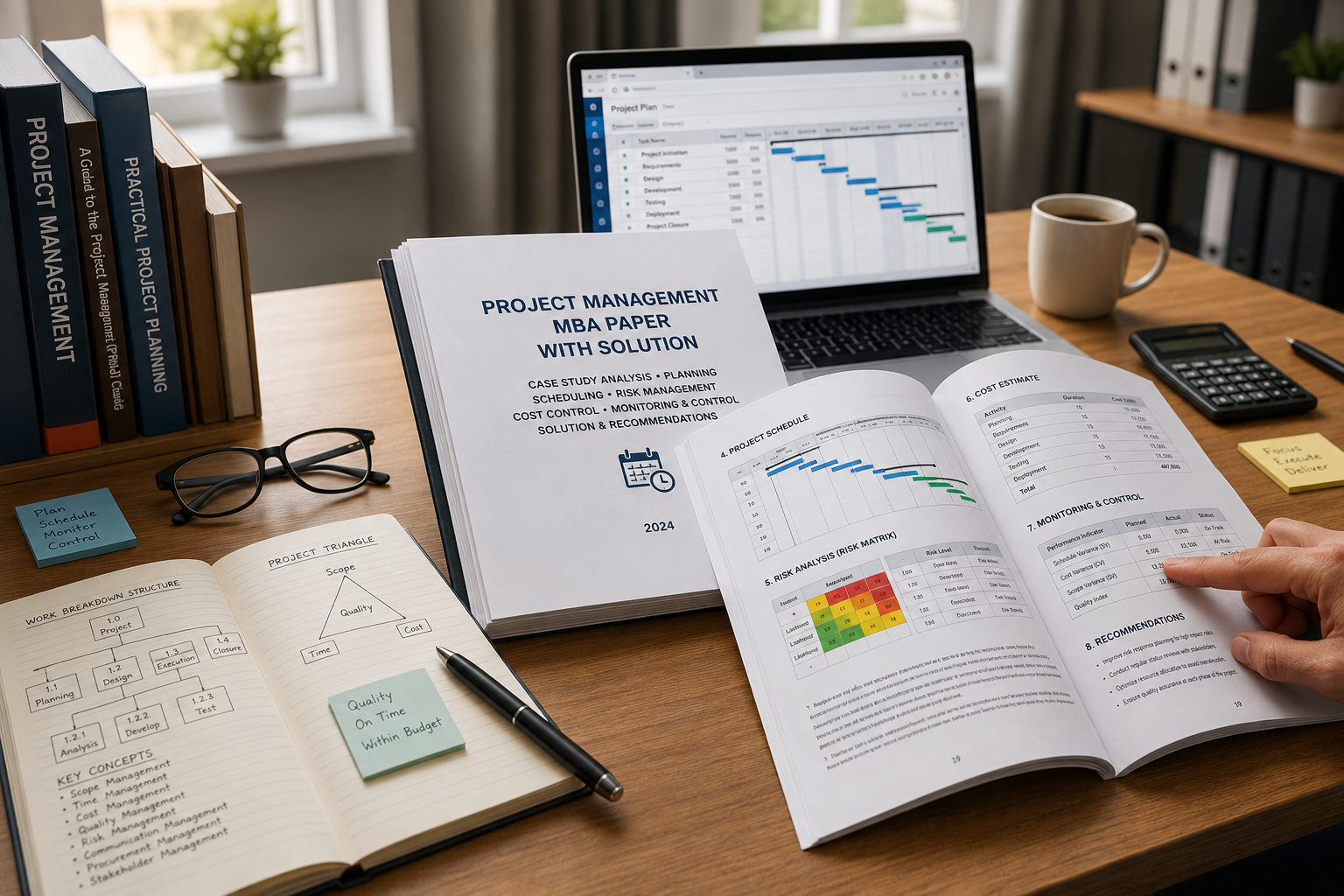
Project Management MBA Paper with Solution
Ask any manager who’s led a project that ran over budget and past deadline, and they’ll tell you the plan looked perfectly reasonable on paper. That gap between planning and execution is exactly why project management exists as its own discipline — not because plans are useless, but because managing the messy reality of turning a plan into results takes a specific skill set.
This paper covers the core questions MBA students typically face on project management, answered the way you’d want to present them on an exam — structured, grounded in real examples, and without unnecessary padding.
Project Management MBA Paper with Solution
Question 1: What Is Project Management?
Project management is the discipline of planning, organizing, and overseeing resources to achieve a specific goal within a defined timeframe and budget. Unlike ongoing business operations, a project has a clear start, a clear end, and a specific deliverable it’s working toward.
Project management typically covers:
- Scope definition and planning
- Resource allocation and scheduling
- Budget management
- Risk identification and mitigation
- Quality control
- Stakeholder communication
What makes project management distinct from general management is this defined boundary — a project succeeds or fails against specific criteria, not an open-ended set of ongoing responsibilities.
Question 2: Explain the Project Management Life Cycle
Most projects, regardless of industry, move through the same broad phases.
Initiation is where the project is formally defined — objectives, feasibility, and a rough sense of scope get established before real resources are committed.
Planning builds out the detail — timelines, budgets, resource assignments, and risk plans get mapped out in this phase, and it’s often the phase most likely to get rushed under time pressure, usually at real cost later.
Execution is where the actual work happens — teams build, produce, or deliver whatever the project is meant to create.
Monitoring and controlling runs alongside execution, tracking progress against the plan and making adjustments as issues surface.
Closure wraps up the project — final deliverables are handed off, resources are released, and lessons learned get documented for future projects.
Skipping or rushing any one of these phases tends to create problems that surface later, often at a point where they’re far more expensive to fix than they would have been earlier.
Question 3: Discuss the Different Project Management Methodologies
Not every project benefits from the same management approach, and choosing the right methodology matters as much as executing it well.
Waterfall
A linear, sequential approach where each phase must be completed before the next begins. Works well for projects with clearly defined requirements and little expected change, like construction or manufacturing.
Agile
An iterative approach that breaks work into short cycles (sprints), allowing teams to adapt based on feedback throughout the project. Common in software development, where requirements often evolve as the product takes shape.
Scrum
A specific Agile framework built around fixed-length sprints, daily stand-up meetings, and defined roles like Scrum Master and Product Owner.
Lean Project Management
Focuses on maximizing value while minimizing waste — time, resources, or effort spent on anything that doesn’t directly contribute to the project’s goal.
Software companies overwhelmingly favor Agile and Scrum because requirements shift constantly as user feedback comes in, while industries like construction or infrastructure typically stick with Waterfall, since the cost of changing direction mid-project is much higher.
Question 4: What Is the Project Management Triangle?
The project management triangle — also called the triple constraint — describes the relationship between three core factors: scope, time, and cost. Asana’s guide to the project management triangle walks through the concept with additional real-world examples if you want to go deeper.
The core idea is simple but important: these three elements are interdependent. Change one, and at least one of the others typically has to shift too.
- Increase scope without adjusting time or budget, and quality usually suffers
- Compress the timeline, and cost typically rises to bring in additional resources
- Cut the budget, and either scope or timeline usually has to give
Experienced project managers use this framework constantly when stakeholders request changes mid-project — it gives a clear, structured way to explain that “just add this feature” almost never comes without a tradeoff somewhere else.
Question 5: Explain Risk Management in Project Management
Risk management involves identifying, assessing, and preparing for events that could disrupt a project’s timeline, budget, or outcomes.
The typical process includes:
- Risk identification — brainstorming potential issues, from resource shortages to technical failures
- Risk assessment — evaluating each risk’s likelihood and potential impact
- Risk prioritization — focusing attention on the highest-impact, highest-likelihood risks first
- Risk response planning — deciding whether to avoid, mitigate, transfer, or accept each risk
- Ongoing monitoring — tracking risks throughout the project, since new ones often emerge as work progresses
A construction project, for example, might identify weather delays as a high-likelihood risk and build buffer time into the schedule specifically to absorb it, rather than treating any delay as an unplanned crisis.
Question 6: What Is a Work Breakdown Structure (WBS)?
A Work Breakdown Structure is a hierarchical breakdown of a project into smaller, more manageable components — essentially a map of everything that needs to get done, organized from major deliverables down to individual tasks.
A well-built WBS helps by:
- Making large projects feel less overwhelming by breaking them into concrete pieces
- Clarifying ownership, since each task can be assigned to a specific person or team
- Improving estimation accuracy for both time and cost
- Making progress easier to track, since smaller tasks are easier to mark complete than vague milestones
Skipping this step often leads to scope creep, where tasks quietly expand because nobody clearly defined their boundaries from the start.
A Practical Example: WBS and the Triangle in Action
It helps to see how these tools work together on an actual project. Consider a mid-sized retailer planning to launch a new e-commerce platform within six months.
The project manager starts by building a Work Breakdown Structure, splitting the project into major components: platform development, payment integration, inventory sync, UI design, and testing. Each of those breaks down further — payment integration alone splits into gateway selection, security compliance, and testing subtasks, each assigned to a specific team member with a clear deadline.
Three months in, marketing requests an additional feature — a loyalty rewards program integrated directly into checkout. This is where the project triangle becomes a genuinely useful conversation tool rather than just a textbook diagram. The project manager lays out the tradeoff plainly: adding this scope without adjusting the deadline would require either additional developers (raising cost) or cutting testing time (raising risk to quality). Stakeholders choose to push the launch date back three weeks rather than compress testing, a decision that turns out to matter significantly once a payment integration bug surfaces during that extended testing window.
Without the WBS, that bug might not have been caught before launch. Without a clear framework for discussing the tradeoff, the loyalty program request could easily have been squeezed in without anyone formally acknowledging the added risk. That’s really the value both tools provide — not just organization, but a shared language for making tradeoffs explicit instead of accidental.
Question 7: Discuss the Role of a Project Manager
A project manager is responsible for planning, executing, and closing out a project while keeping scope, time, cost, and quality in balance.
Key responsibilities include:
- Defining project scope and objectives with stakeholders
- Building and managing the project schedule and budget
- Coordinating team members and resolving conflicts
- Communicating progress and issues to stakeholders
- Managing risk and adapting plans as circumstances change
Strong project managers tend to combine technical planning skills with genuine leadership ability — the best schedule in the world doesn’t execute itself, and keeping a team motivated through a difficult stretch is often just as important as the Gantt chart.
Why Project Management Matters in MBA Programs
Project management gives MBA students a practical, execution-focused skill set that applies across nearly every industry and function, regardless of career track.
Studying project management helps students:
- Learn to translate strategy into concrete, executable plans
- Build skills in resource allocation and budget management
- Develop stronger risk assessment and contingency planning abilities
- Prepare for leadership roles that require coordinating cross-functional teams
- Understand how to manage stakeholder expectations realistically
This ties closely into the operational thinking covered in our Operations Management MBA paper, since project management and operations both depend heavily on planning, resource allocation, and process discipline.
Common Challenges in Project Management
Scope Creep
Uncontrolled expansion of a project’s requirements — often through small, seemingly reasonable additions — is one of the most common reasons projects run over budget and past deadline.
Resource Constraints
Limited budget, staffing, or equipment forces project managers to make constant tradeoffs, and poor resource planning early on tends to surface as bottlenecks later.
Poor Communication
Misaligned expectations between stakeholders and the project team are a frequent source of delays and rework, particularly on projects involving multiple departments or external partners.
Unrealistic Timelines
Pressure to deliver quickly sometimes leads to schedules that don’t reflect actual complexity, setting a project up for stress and quality issues from the start.
Tips to Write Strong Project Management MBA Answers
Reference Recognized Frameworks
Bringing in models like the project triangle, WBS, or Agile/Waterfall comparisons gives an answer clear structure and academic grounding.
Use Concrete Project Examples
Referencing a real or plausible project scenario — a software launch, a construction build, a marketing campaign rollout — makes an answer far more convincing than abstract theory alone.
Show Awareness of Tradeoffs
Strong answers acknowledge that project decisions almost always involve tradeoffs between scope, time, and cost, rather than presenting solutions as risk-free.
Structure Answers Around Process
Project management questions often involve sequential steps, so laying out a clear process — like the risk management steps above — tends to score better than a loose narrative.
FAQs
What is the main goal of project management?
The main goal is to deliver a specific outcome within defined scope, time, and budget constraints, while managing risk and stakeholder expectations along the way.
What’s the difference between Agile and Waterfall methodologies?
Waterfall follows a linear, sequential process best suited to projects with fixed requirements, while Agile uses iterative cycles that allow for ongoing adjustment as requirements evolve.
Why does the project management triangle matter?
Because it illustrates that scope, time, and cost are interdependent — changing one almost always affects at least one of the others, which helps set realistic expectations with stakeholders.
What is scope creep, and why is it a problem?
Scope creep refers to a project’s requirements gradually expanding beyond its original plan, often causing budget overruns and missed deadlines if it isn’t actively managed.
Is project management relevant outside of formal PM roles?
Yes. Nearly every management role involves some form of planning, coordinating resources, and delivering results within constraints, making project management skills broadly useful across careers.
Final Verdict
Project management bridges the gap between a good idea and a delivered result — the discipline that turns strategy into something concrete, on schedule, and within budget. For MBA students, understanding project management means understanding that execution is its own skill, separate from planning, and that the ability to adapt when reality doesn’t match the plan is often what actually separates successful projects from the ones that quietly stall out. That kind of practical, execution-focused thinking holds real value across virtually every management role.