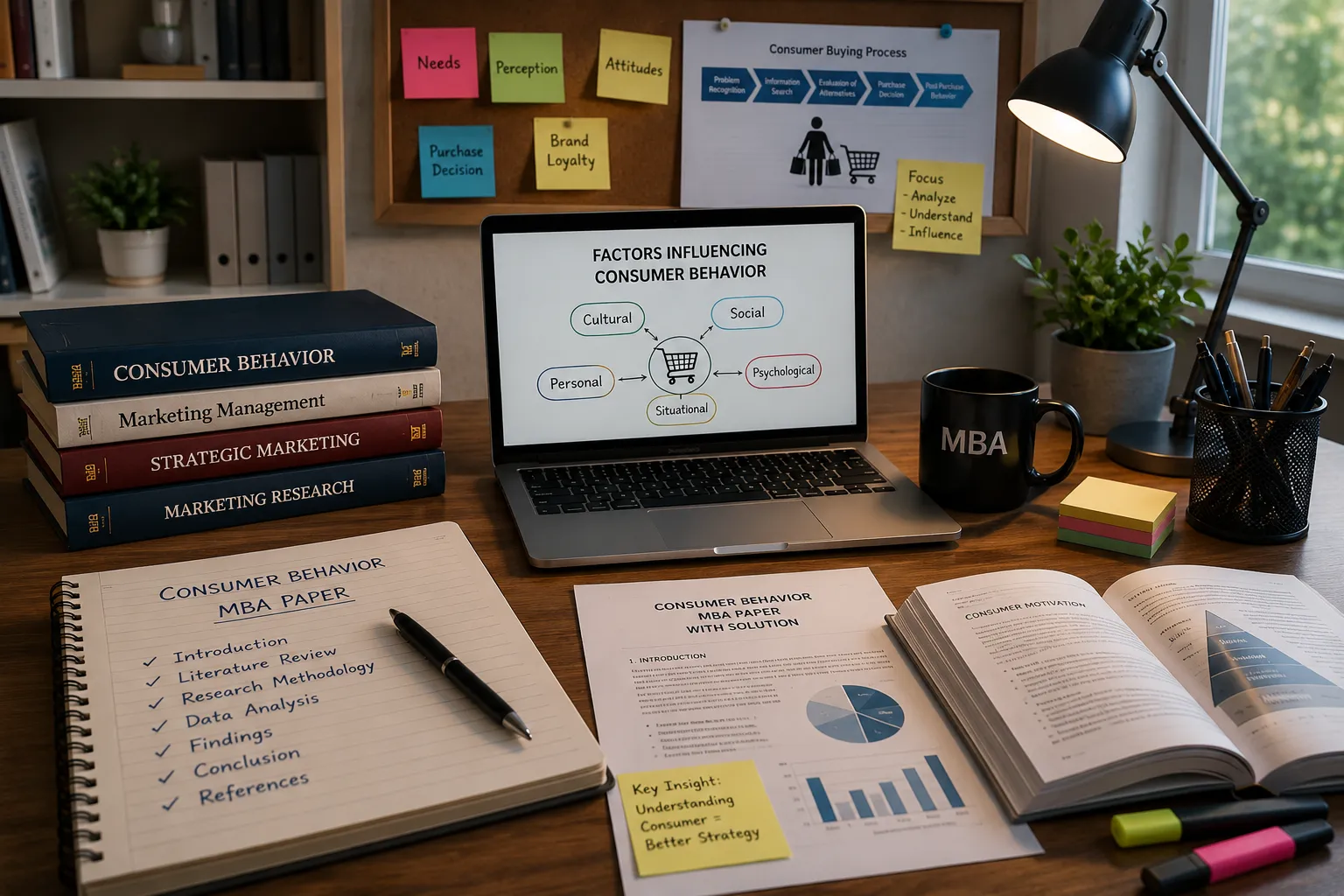
Consumer behaviour is the study of why people buy what they buy — and for MBA students it is where marketing stops being guesswork. Moreover, every pricing, product and promotion decision rests on an assumption about how buyers think, search, choose and judge afterwards. Furthermore, this paper solution works through the discipline in the order an examiner asks it. In addition, it covers the decision process, the psychological and social forces acting on it, segmentation, and buying behaviour types. Moreover, it also covers perception and the changes digital technology has brought. Two examples are worked in full, because a percentage you can calculate is worth more in an exam than a definition you can only repeat.
What Consumer Behavior Actually Means
Furthermore, consumer behaviour is the study of how individuals, groups and organisations select, buy, use and dispose of goods, services and ideas. In addition, they do so to satisfy their needs and wants. However, it draws on psychology (how people perceive and learn) and sociology (how groups influence members). Consequently, it also draws on anthropology (how culture shapes habits) and economics (how income constrains choice). That mixture is exactly why the subject sits inside a marketing degree: it supplies the evidence base for the decisions covered in our Marketing Management MBA paper.
In addition, three features of the definition deserve marks. First, the subject covers the whole journey, not just the moment of purchase — what happens before (search, comparison). Similarly, after (satisfaction, disposal, recommendation) matters just as much. Second, the buyer is not always the user. A parent buying a laptop for a student is influenced by the student’s preferences even though the student never visits the shop. Third, behaviour is studied to be influenced ethically, not manipulated. For example, the aim is to match offers to real needs more accurately than competitors do.
The Consumer Decision-Making Process: Its Stages
Meanwhile, the standard model breaks a purchase into five stages. Therefore, Problem recognition: the buyer notices a gap between their actual state and a desired state. For example, a phone battery that no longer lasts the day. However, Information search: they gather options, from memory first, then reviews, friends and shops. Moreover, Evaluation of alternatives: options are scored against criteria such as price, quality and brand. Consequently, Purchase decision: the choice is made, though stock, delivery terms or a salesperson can still change it. Furthermore, Post-purchase behaviour: satisfaction or disappointment decides repeat buying and word of mouth.
Similarly, not every purchase passes through all five stages. In addition, a routine purchase of toothpaste may move from recognition straight to buying. Meanwhile, a car purchase may spend weeks in search and evaluation. For example, the model’s value to a manager is diagnostic: it shows where buyers are being lost.
Worked Example 1: A Decision Funnel for an Online Store
Therefore, a fictional online electronics store tracked 1,200 visitors who viewed a laptop page in one week. It recorded how far each travelled through the decision process:
| Stage | People | Conversion to next stage |
|---|---|---|
| Viewed the product page | 1,200 | — |
| Added a laptop to the basket (recognition/search complete) | 480 | 480 ÷ 1,200 = 40% |
| Compared models on the comparison page (evaluation) | 240 | 240 ÷ 480 = 50% |
| Completed the purchase | 150 | 150 ÷ 240 = 62.5% |
Overall conversion = 150 ÷ 1,200 = 12.5%. In short, read the funnel as a manager would. The biggest absolute loss is at the first step. 720 of 1,200 viewers never added anything, which points at the product page itself. The causes are unclear benefits, weak photographs or an unconvincing price. The evaluation stage loses half its people, suggesting comparison information is hard to use. Moreover, the final stage converts well, so checkout is not the problem. The funnel turns “sales are low” into two specific repairs, in priority order.
The Psychological Factors That Influence Buying
Furthermore, four psychological factors appear in almost every paper. Motivation is the drive to close the gap the buyer feels. Maslow’s hierarchy is the usual framework. It reminds marketers that a product can be sold at several levels. A car can be sold as transport (physiological/safety), as reliability for family (safety), or as status (esteem). In addition, Perception, covered fully in Question 7, is how buyers select, organise and interpret information. Two people can see the same advertisement and take away opposite meanings. For example, Learning is the change in behaviour from experience: a good first experience builds brand loyalty. A bad one teaches avoidance just as efficiently. Beliefs and attitudes are the stored evaluations buyers carry about brands; attitudes are slow to form and slow to change. Therefore, this is why firms defend reputation so fiercely and why changing a negative attitude usually takes evidence, not slogans.
Name the factor, state the mechanism in one sentence, then give its marketing consequence. “Motivation matters” earns nothing; “because buyers at the esteem level respond to status cues, the same watch is advertised with achievement imagery rather than price” earns the mark.
How Social and Cultural Factors Shape Consumer Behavior
However, buyers do not decide alone. Culture — the values and habits absorbed from society — sets the outer frame. Food preferences, attitudes to credit, and what counts as an appropriate gift all vary by culture. A campaign that succeeds in one market can fail flatly in another. Similarly, Subcultures (regional, religious, generational groups within a culture) refine the frame further. Social class influences both purchasing power and the signals buyers want their purchases to send.
Closer to the individual, reference groups — friends, colleagues, online communities, admired figures — supply standards buyers compare themselves against. Meanwhile, this is the mechanism behind influencer marketing in our Digital Marketing MBA paper. The family is the most powerful reference group of all, because roles inside it (who suggests, who decides, who pays, who uses) shape purchases from groceries to holidays. A strong answer treats these as layers: culture frames the choice, groups steer it, family finalises it.
Market Segmentation Based on Consumer Behavior
In short, segmentation divides a market into groups of buyers who share characteristics and respond similarly to an offer. The bases are geographic (where buyers live) and demographic (age, income, family stage). They also include psychographic (lifestyle, values) and behavioural (usage rate, loyalty, benefits sought). Behavioural segmentation is usually the most powerful for marketers because it groups people by what they actually do, not by what they are. Survey data like this is analysed with the methods in our Business Statistics MBA paper.
Worked Example 2: Sizing Segments From a Survey
A fictional meal-kit company surveys 600 adults in a city of 120,000 potential buyers. It asks which age group they fall into, to estimate the size of each demographic segment. Furthermore, segment size = (respondents in group ÷ total respondents) × total market.
| Age group | Survey respondents | Share | Estimated segment size |
|---|---|---|---|
| 18–24 | 180 | 180 ÷ 600 = 30% | 30% × 120,000 = 36,000 |
| 25–34 | 240 | 240 ÷ 600 = 40% | 40% × 120,000 = 48,000 |
| 35–49 | 120 | 120 ÷ 600 = 20% | 20% × 120,000 = 24,000 |
| 50+ | 60 | 60 ÷ 600 = 10% | 10% × 120,000 = 12,000 |
Now make it a decision. In addition, the 25–34 segment is the largest at 48,000 people. If the company targets it and converts a realistic 8% in year one, that is 48,000 × 8% = 3,840 customers. At an average spend of $45 a month on meal kits, monthly revenue from this segment alone would be 3,840 × $45 = $172,800. Two exam cautions belong in the answer. For example, the estimate assumes the survey sample represents the city (a biased sample corrupts every figure after it). Segments must also be reachable and willing to buy — size alone does not make a segment attractive.
The Four Types of Buying Behaviour
Therefore, buying behaviour varies with two things: how involved the buyer is, and how different the brands seem. Complex buying behaviour — high involvement, big perceived differences — fits cars and laptops: long search, careful evaluation. However, Dissonance-reducing behaviour — high involvement, few perceived differences — fits carpets or insurance. The buyer buys, then worries they chose wrongly, so reassurance after purchase matters.
Consequently, Habitual buying behaviour — low involvement, few differences — fits salt and sugar. The buyer reaches for the familiar brand without thinking, and advertising works by repetition. Variety-seeking behaviour — low involvement, real differences — fits biscuits and shampoo: buyers switch for novelty, not dissatisfaction, so even the market leader loses customers who are perfectly happy. The managerial point is that each type demands a different strategy. Complex buyers need information, dissonant ones need reassurance, habitual ones need shelf visibility, and variety seekers need constant small innovations.
Perception in Consumer Behavior: Its Role
Perception is the process by which buyers select, organise and interpret information to form a picture of the world — and buyers act on the picture, not on reality. Similarly, three mechanisms matter. Selective attention: buyers notice only a fraction of the messages aimed at them, usually those connected to a current need. An advert must earn attention in seconds. Selective distortion: buyers bend new information to fit existing beliefs — a loyal customer forgives a fault that would confirm a sceptic’s worst opinion. Meanwhile, Selective retention: buyers remember points that support their choices and forget the rest. This is why satisfied customers become a brand’s unpaid sales force.
Perception also explains why price is read as a quality signal when buyers cannot judge quality directly. It also explains why packaging shape changes how much people pour, and why the first review on a page anchors later judgements. In short, for managers the lesson is humbling: improving the product is only half the task. The improvement must also be perceived, which is a communication problem, not an engineering one.
How Digital Technology Changed Consumer Behavior
Moreover, digital technology has rebalanced power from sellers to buyers in four ways. First, information: reviews, price-comparison tools and unboxing videos mean buyers often know more about a product than the salesperson does. Second, the path to purchase: search and purchase now happen anywhere, at any hour. The stages of Question 2 compress — a buyer can move from recognition to checkout in two minutes on a phone. Third, social proof at scale: ratings and visible customer numbers act as reference groups of thousands.
A run of negative reviews can close a business that a decade ago would have survived on passing trade. Furthermore, fourth, data-driven personalisation: firms track behaviour and tailor offers. Buyers enjoy this when it saves them time, and resent it when it feels like surveillance. In addition, the personalisation–privacy balance is now a standing item in consumer research. Managing the customers won this way is the subject of our Customer Relationship Management MBA paper.
Case Study: BloomBasket Learns to Read the Funnel
For example, BloomBasket is a fictional online florist created for this paper. Its founder assumed buyers chose purely on price and competed with constant discounts — yet margins shrank while repeat orders stayed flat. A simple review of the buying process changed her mind.
She found that most orders were occasion-driven gifts (recognition triggered by a birthday reminder, not by advertising). Buyers compared only two or three bouquets before choosing (evaluation was short and visual). Post-purchase messages — a photo of the delivered bouquet — produced most of her five-star reviews and repeat orders. She stopped discounting. Moreover, she invested instead in reminder emails before family birthdays (supporting recognition). She simplified each bouquet page to three clear photographs (supporting fast evaluation). She kept the delivery photo (strengthening post-purchase satisfaction). Therefore, the insight was behavioural, not financial: BloomBasket did not have a pricing problem. It had a decision-process problem, and each fix was aimed at a named stage.
Consumer Behavior: Quick Answers
What is the difference between a customer and a consumer?
However, the customer buys the product; the consumer uses it. They are often the same person, but when they differ — a parent buying cereal a child eats — the marketer must influence both. Consequently, influence the buyer on value and trust, and the user on taste and preference.
Why do marketers study post-purchase behaviour so closely?
Because satisfaction after purchase decides repeat buying, returns and word of mouth. Similarly, a disappointed buyer costs more than one lost sale — they warn others. Post-purchase communication, easy returns and honest quality all protect the cheapest revenue a firm has: the next order from an existing customer.
Does the five-stage decision process apply to every purchase?
No. It describes considered purchases best. Meanwhile, habitual, low-involvement buying skips most stages. The model’s value is diagnostic. It shows which stage a particular purchase really uses, and therefore where marketing effort belongs — awareness for one product, reassurance for another.
Is personalisation good or bad for consumers?
In short, both, depending on execution. Relevant recommendations save time and surface useful products; intrusive tracking and manipulative targeting erode trust and increasingly attract regulation. Moreover, the sustainable position for a firm is personalisation with consent and visible benefit to the buyer.
Reading Buyers Before They Reach the Till
Consumer behaviour rewards students who think like detectives. Observe what buyers do, locate it in the decision process, and name the psychological or social force behind it. Only then recommend an action. Furthermore, practise on your own purchases for a week, and the theory in this paper will never feel abstract again.
8 thoughts on “Consumer Behavior MBA Paper with Solution”