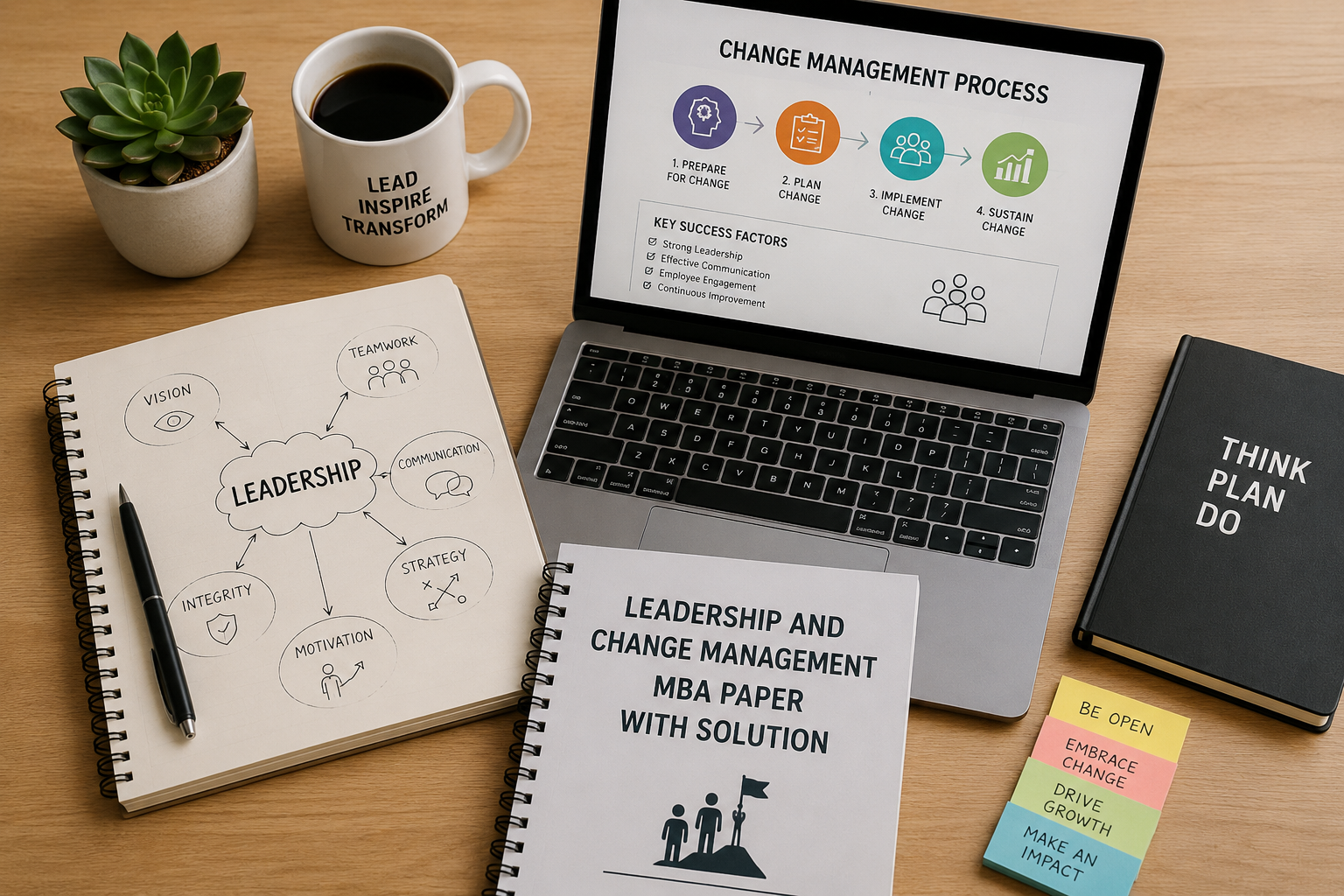
A new strategy looks great in a slide deck. Getting an entire organization to actually follow it is a different challenge entirely. That gap is exactly where leadership and change management come in. Good leadership sets the direction. Good change management makes sure people actually follow it, without the whole effort falling apart along the way.
This paper covers the core questions MBA students face on leadership and change management. Each answer is structured, backed by real examples, and written the way you’d want to present it on an exam.
Leadership and Change Management MBA Paper with Solution
Question 1: What Is Leadership, and How Does It Differ from Management?
Leadership is the ability to influence, inspire, and guide individuals or teams toward a shared goal. Management, by contrast, focuses more on planning, organizing, and controlling resources to meet specific objectives.
The distinction matters:
- Leaders inspire vision. Managers execute plans.
- Leaders often challenge the status quo. Managers maintain stability and process.
- Leaders build relationships and trust. Managers coordinate tasks and resources.
In practice, most effective executives blend both skill sets. A great leader without management discipline struggles to execute. A great manager without leadership ability struggles to inspire real commitment from a team.
Question 2: Explain the Major Leadership Theories
Leadership theory has evolved significantly over the past century, and MBA exams often test familiarity with the major schools of thought.
Trait Theory
Early leadership theory assumed leaders were simply born with certain traits, like confidence or charisma. Modern research has largely moved past this, recognizing leadership as something that can be developed.
Behavioral Theory
Focuses on what leaders actually do, rather than who they are. This shifted the conversation toward leadership as a set of learnable behaviors.
Contingency Theory
Argues that effective leadership depends on the situation. A style that works well during a crisis might fail completely during stable, routine operations.
Transformational Leadership
Centers on inspiring and motivating followers toward a shared vision, often driving higher engagement and innovation.
Servant Leadership
Flips the traditional hierarchy. The leader’s primary role becomes serving the needs of the team, rather than the other way around.
Satya Nadella’s leadership at Microsoft is often cited as a transformational example. His shift toward a growth mindset culture is widely credited with reviving the company’s innovation and morale.
Question 3: What Are the Key Leadership Styles?
Leadership style shapes how decisions get made and how teams respond to direction.
Autocratic leadership centralizes decision-making with the leader. It’s fast, but can suppress team input over time.
Democratic leadership involves the team in decisions. It tends to build stronger engagement, though it can slow things down when speed really matters.
Laissez-faire leadership gives teams significant autonomy. It works well with highly skilled, self-directed groups, but can leave less experienced teams without enough guidance.
Transactional leadership relies on structured rewards and penalties tied to performance. It works well in stable, process-driven environments.
The right style depends heavily on context. A startup facing a funding crisis usually needs more directive leadership. A mature, experienced team often thrives with more autonomy instead.
Question 4: What Is Change Management?
Change management is the structured approach to preparing, supporting, and guiding individuals and organizations through transitions — whether that’s new technology, restructuring, or a shift in strategy.
Change management typically covers:
- Planning and communicating the change
- Managing resistance
- Training and supporting employees through the transition
- Reinforcing the change so it actually sticks
Without deliberate change management, even well-designed strategic shifts often fail. Not because the strategy was wrong, but because people weren’t brought along effectively.
Question 5: Explain Kurt Lewin’s Change Management Model
Lewin’s model remains one of the most widely taught change frameworks, largely because of its simplicity.
Unfreezing is the first stage. It involves building awareness that change is genuinely necessary, often by highlighting problems with the current state.
Changing is the second stage. This is where the actual transition happens, whether that’s new processes, systems, or organizational structure.
Refreezing is the final stage. It focuses on reinforcing the new state so it doesn’t quietly slide back into old habits once the initial push fades.
Skipping refreezing is a common mistake. Organizations often declare victory once a change is implemented, without doing the work to make it permanent. Old habits creep back in surprisingly fast without reinforcement.
Question 6: Why Do Employees Resist Change, and How Can Resistance Be Managed?
Resistance to change is normal. Understanding its roots helps leaders manage it more effectively.
Common sources of resistance include:
- Fear of the unknown — uncertainty about how change will affect a person’s role or job security
- Loss of control — feeling that decisions are being made without meaningful input
- Habit and comfort — familiar routines feel safer, even when they’re less efficient
- Distrust in leadership — past experiences with poorly handled change can make people skeptical
Managing resistance well generally comes down to clear communication, genuine involvement, and addressing concerns directly rather than dismissing them. Employees who feel heard tend to resist far less than those who feel change is simply happening to them.
Question 7: What Is Kotter’s 8-Step Change Model?
John Kotter’s model expands on Lewin’s simpler framework, breaking change into eight specific steps.
- Create urgency — help people understand why change is necessary now
- Build a guiding coalition — assemble a team with enough influence to lead the effort
- Form a strategic vision — clarify what the change is actually trying to achieve
- Enlist a volunteer army — build broad support beyond just leadership
- Enable action by removing barriers — clear obstacles that block progress
- Generate short-term wins — early visible successes build momentum
- Sustain acceleration — keep pushing after initial wins, rather than slowing down too early
- Institute change — embed the change into company culture so it becomes the new normal
Kotter’s model is more detailed than Lewin’s, and many organizations use it specifically because it addresses momentum, something Lewin’s simpler three-stage model doesn’t emphasize as directly.
Question 8: What Role Does Emotional Intelligence Play in Leadership?
Emotional intelligence is the ability to recognize, understand, and manage your own emotions, while also reading and responding well to the emotions of others. MindTools’ guide to emotional intelligence in leadership breaks down each component in more detail.
Daniel Goleman’s framework breaks emotional intelligence into five components:
- Self-awareness — understanding your own emotional triggers and reactions
- Self-regulation — managing impulses and staying composed under pressure
- Motivation — maintaining drive and resilience, even through setbacks
- Empathy — genuinely understanding how others feel and why
- Social skills — building relationships and navigating interpersonal dynamics effectively
Leaders with high emotional intelligence tend to handle conflict better and build stronger trust within their teams. During change initiatives especially, this matters enormously. A leader who senses growing anxiety on a team, before it turns into open resistance, can address it early. One who misses those signals often gets blindsided by pushback that could have been managed proactively.
Why Leadership and Change Management Matter in MBA Programs
Nearly every strategic initiative depends on effective leadership and successful change execution, making this one of the more universally applicable MBA subjects.
Studying leadership and change management helps students:
- Build the skills to inspire and guide teams through uncertainty
- Understand why well-designed strategies still sometimes fail
- Learn structured frameworks for managing organizational transitions
- Prepare for roles requiring genuine influence, not just authority
- Recognize and address resistance before it derails progress
This connects closely to the team dynamics covered in our Organizational Behavior MBA paper, since leadership style and change management both depend heavily on understanding how people actually behave within organizations.
A Practical Example: Leading Change Through Resistance
Consider a mid-sized retail company shifting from in-store-only sales to a hybrid online and physical model. Store staff worry the shift threatens their jobs. Sales resist adopting the new digital tools.
Leadership starts with Kotter’s early steps. They create urgency by sharing data showing competitors already pulling ahead online. They build a guiding coalition, including respected senior staff who support the shift, not just executives.
Rather than mandating the change top-down, leadership holds sessions addressing specific fears directly. Staff learn the shift adds a new sales channel, rather than replacing their roles entirely. Early wins get celebrated publicly, like the first month hitting online sales targets.
Six months in, resistance has genuinely eased. Staff who once resisted are now suggesting further improvements themselves. The difference wasn’t a better strategy on paper. It was leadership that addressed fear directly, instead of assuming compliance would just happen.
Common Challenges in Leadership and Change Management
Inconsistent Communication
Mixed messages from different leaders create confusion and erode trust, especially during periods of major transition.
Underestimating Emotional Impact
Change affects people emotionally, not just operationally. Leaders who ignore this often face deeper resistance than expected.
Short-Term Thinking
Organizations sometimes declare success too early, without reinforcing new behaviors long enough for them to genuinely stick.
Leadership Misalignment
When senior leaders aren’t fully aligned on a change initiative, that inconsistency filters down and undermines the entire effort.
Tips to Write Strong Leadership and Change Management MBA Answers
Use Real Leaders and Companies as Examples
Referencing figures like Satya Nadella or documented corporate transformations shows applied understanding, not just memorized theory.
Reference Established Frameworks
Bringing in models like Lewin’s three stages or Kotter’s eight steps gives an answer clear structure and academic weight.
Address the Human Side of Change
Strong answers acknowledge emotional resistance, not just process and strategy, since that’s often where change efforts genuinely succeed or fail.
Keep Structure Clear
Leadership and change questions often involve stages or steps. Clear headings make answers easier to follow and grade well.
FAQs
What is the main difference between leadership and management?
Leadership focuses on inspiring vision and direction, while management focuses on planning, organizing, and controlling resources to meet specific goals.
Why do most change initiatives fail?
Most failures come down to poor communication, unmanaged resistance, and rushing past the reinforcement stage before new behaviors genuinely take hold.
What’s the difference between Lewin’s and Kotter’s change models?
Lewin’s model offers three broad stages, while Kotter’s expands this into eight specific steps, with more emphasis on building momentum and sustaining change over time.
How can leaders reduce employee resistance to change?
Through clear, honest communication, genuine involvement in the process, and directly addressing specific fears rather than dismissing them.
Is leadership something people are born with, or can it be developed?
Modern research strongly supports that leadership skills can be developed through experience, training, and deliberate practice, not just innate traits.
Final Verdict
Leadership and change management give MBA students the tools to turn strategy into something people actually follow. A brilliant plan means little if an organization can’t execute it, and execution ultimately depends on people. Students who understand both subjects walk away with a genuine advantage, since guiding people through uncertainty is a skill that matters in nearly every leadership role, regardless of industry.
1 thought on “Leadership and Change Management MBA Paper with Solution”