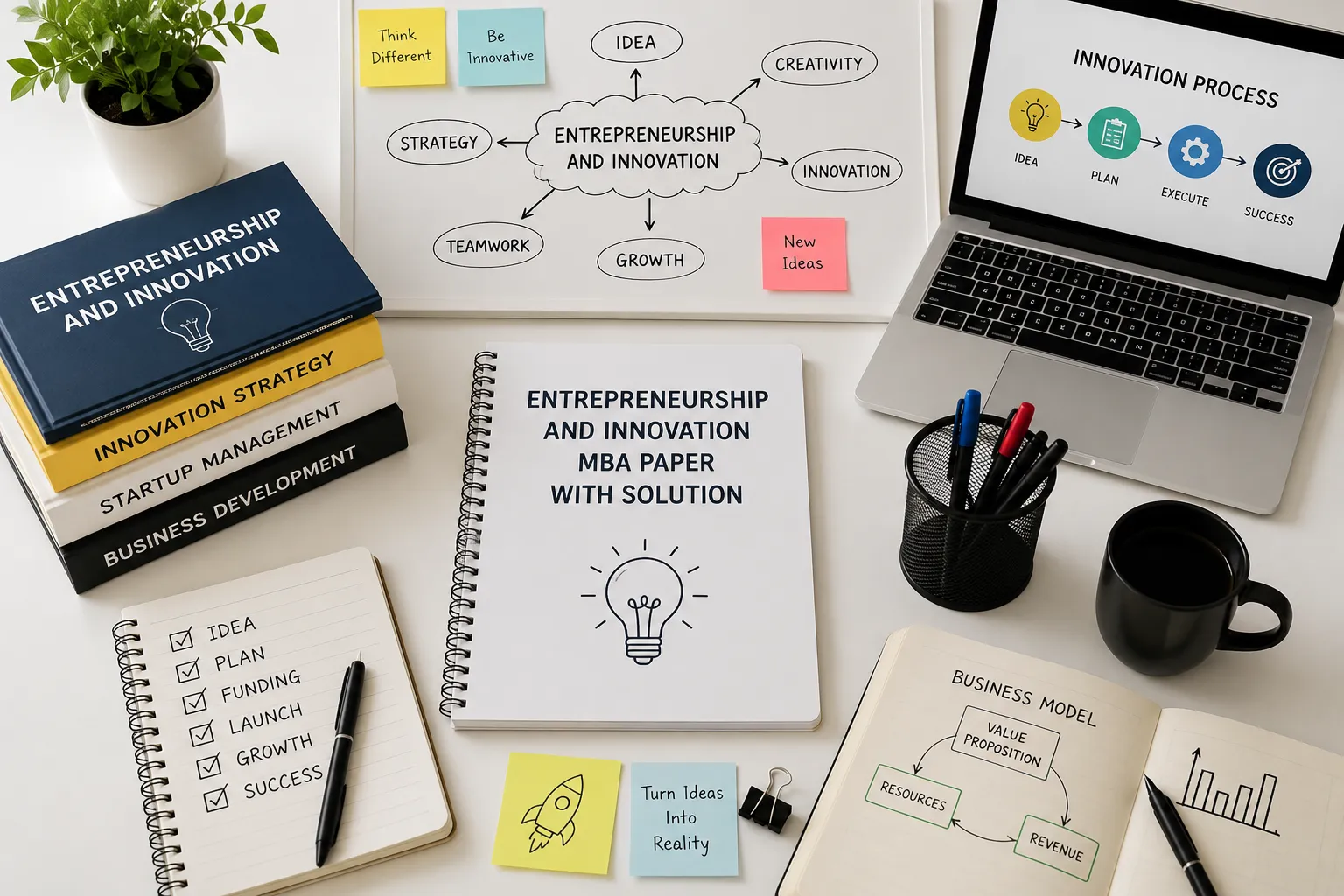
Most new ventures do not fail because the founder lacked passion; they fail because the money ran out before the idea was ever tested. Entrepreneurship, studied properly, is the discipline that prevents that: spotting an opportunity, modelling it honestly, testing it cheaply, and knowing — in figures — how long the cash lasts. This paper solution works through what entrepreneurship is, its types and process, the business model canvas, innovation, venture capital and the lean startup method, with a break-even and cash-runway calculation and an MVP test worked in full.
What Entrepreneurship Actually Means
Entrepreneurship is the process of identifying an opportunity, assembling the resources to pursue it, and creating something of value under conditions of uncertainty. The entrepreneur is not simply a business owner. A person who buys an established shop and runs it as its previous owner did is managing; a person who spots an unmet need, builds an organisation around it and bears the risk that the need may not pay is entrepreneuring.
Three elements deserve emphasis in an exam answer. First, opportunity: entrepreneurship begins with a gap — an unserved customer, an inefficiency, a technology looking for a problem. Second, resource assembly: entrepreneurs rarely own what they need at the start, so persuasion — of co-founders, suppliers, lenders and first customers — is a core skill. Third, uncertainty: the returns cannot be calculated the way a routine investment’s can, which is why staged testing, covered later in the lean startup question, matters so much.
The Main Types of Entrepreneurship
- Small business entrepreneurship: local firms — cafés, agencies, trades — built to serve a known market profitably rather than to dominate an industry.
- Scalable start-ups: ventures designed from day one to grow very large, usually technology-based, and the natural audience for venture capital.
- Social entrepreneurship: ventures whose primary return is a social outcome — clean water, affordable tutoring — with financial sustainability as the means, not the end.
- Intrapreneurship: entrepreneurial behaviour inside a large organisation, where employees develop new products or ventures using the firm’s resources.
- Lifestyle entrepreneurship: businesses designed around the founder’s desired life — a surf school, a specialist tour company — where control and flexibility outrank growth.
The classification is examinable because the type dictates everything else: funding source, growth ambition, acceptable risk and what “success” even means. Judging a lifestyle business by venture-capital standards, or a scalable start-up by corner-shop standards, produces nonsense conclusions.
The Stages of the Entrepreneurial Process
The standard sequence runs: opportunity identification → evaluation → resource assembly → launch → growth management. Identification comes from noticing problems — in a job, as a frustrated customer, or through a technology shift. Evaluation asks the hard questions: is the need real, is the market large enough, can this be delivered at a cost below the price customers will pay? Resource assembly covers the team, premises, suppliers and finance — the funding logic follows the appraisal methods in our Corporate Finance MBA paper. Launch turns the plan into trading, and growth management is where many founders struggle, because the skills that start a firm (improvisation, personal selling) differ from those that scale it (systems, delegation, hiring managers).
Present the process as iterative, not a staircase. Evaluation findings send founders back to reshape the opportunity; launch feedback reshapes the product. Answers that show the loops score higher than answers that list five clean stages.
The Business Model Canvas: Organising a Venture
The Business Model Canvas sets a whole business on one page of nine blocks: customer segments, value proposition, channels, customer relationships, revenue streams, key resources, key activities, key partners and cost structure. Its power is in the connections it forces into the open. A value proposition aimed at busy professionals (segments) implies delivery channels and service levels (channels, relationships) that imply a cost structure — and the canvas makes a founder check, at a glance, whether the revenue streams can carry those costs.
It also disciplines the conversation with investors and mentors: instead of a forty-page plan nobody reads, the team argues about nine boxes and the assumptions inside them — assumptions the lean startup method then tests. Understanding what each segment values is the research task covered in our Consumer Behavior MBA paper.
Worked Example 1: Break-Even and Cash Runway for a New Subscription Venture
Two calculations decide whether a young venture survives long enough to grow. State both formulas first:
Break-even units = Fixed costs ÷ (Price − Variable cost per unit)
Cash runway = Cash available ÷ Monthly net burn
A meal-kit start-up has monthly fixed costs of $8,000 (kitchen rent, salaried staff, software). It sells each kit for $25; ingredients, packaging and delivery cost $10 per kit, so contribution is $15 per kit.
- Break-even = $8,000 ÷ $15 = 533.3, so the venture must sell 534 kits a month before it stops losing money.
- At 700 kits a month, profit = (700 × $15) − $8,000 = $10,500 − $8,000 = $2,500 a month.
- The founders hold $180,000 of raised capital and currently burn a net $15,000 a month, so runway = $180,000 ÷ $15,000 = 12 months.
| Measure | Working | Result |
|---|---|---|
| Contribution per kit | $25 − $10 | $15 |
| Break-even volume | $8,000 ÷ $15 | 534 kits / month |
| Profit at 700 kits | (700 × $15) − $8,000 | $2,500 / month |
| Cash runway | $180,000 ÷ $15,000 | 12 months |
Read the two figures together and the strategy writes itself: the venture has 12 months to climb from launch volume to 534 kits a month, and every month below break-even shortens the runway. That is why founders track these two numbers weekly, not the flattering ones.
Innovation vs Invention: The Real Difference
An invention is a new device, method or idea. An innovation is an invention — or any new combination — successfully applied and adopted: it creates value that someone uses or pays for. The difference is commercial and practical, not technical. Laboratories are full of inventions that never became innovations because they were too costly, too early, or solved a problem nobody had.
The distinction matters to managers because the skills differ. Invention rewards technical brilliance; innovation additionally requires development, pricing, distribution and customer education — the whole apparatus of the Marketing Management MBA paper. In an answer, state it in one line: invention creates knowledge, innovation creates value.
The Types of Innovation in Entrepreneurship
- Product innovation: a new or significantly improved good or service — a first smartphone, or a bank’s instant-payment feature.
- Process innovation: a new way of producing or delivering — self-checkout, or a factory’s shift to just-in-time supply.
- Business model innovation: changing how value is captured — subscriptions instead of purchases, or a platform taking commission instead of selling stock.
- Incremental innovation: small, continuous improvements to what exists; low risk, and where most innovation effort actually sits.
- Radical (disruptive) innovation: a change that reshapes a market and can strand incumbents’ skills and assets — streaming’s effect on video rental.
Strong answers note the risk gradient: incremental innovation rarely fails expensively; radical innovation fails often but is the only kind that reorders industries. A healthy firm runs both, budgeted differently.
Venture Capital in Entrepreneurship: What Role It Plays
Venture capital (VC) is equity finance provided to young, high-growth ventures that cannot borrow conventionally — they have no assets to secure a loan and often no profits yet. In exchange for shares, the VC fund supplies capital in staged rounds, each stage conditional on evidence: prototype, first customers, revenue growth. The staging is the point — it limits the fund’s loss on failures while reserving the right to back winners harder.
VCs also supply things money cannot easily buy: recruitment networks, introductions to first large customers, and the discipline of board-level scrutiny. The cost is real — founders give up a substantial share of ownership and some control, and accept pressure for rapid growth and an eventual exit. That is why VC suits only the scalable start-up type from Question 2: a profitable lifestyle business would be damaged, not helped, by taking it.
The Lean Startup Method: Reducing Risk
The lean startup replaces the traditional sequence — write a full plan, build the full product, then discover whether anyone wants it — with a loop: build a minimum viable product (MVP), measure real customer behaviour, learn, and persevere or pivot. An MVP is the smallest version that tests the riskiest assumption: a landing page describing a service that does not yet exist, a pilot menu in one neighbourhood, a hand-made version of what software will later automate.
Worked Example 2: Testing an Idea With an MVP Before Building It
A team considering a study-notes subscription service built a single landing page describing the service at $9 a month, with a sign-up button, and drove 2,000 visitors to it with a small advertising spend. The results, stage by stage:
| Stage | People | Conversion |
|---|---|---|
| Landing page visitors | 2,000 | — |
| Email sign-ups | 340 | 17% of visitors |
| Paid beta subscribers | 85 | 25% of sign-ups (4.25% of visitors) |
Interpretation: a 17% sign-up rate on cold traffic is strong evidence of real interest — comparable pages for weak ideas typically convert in low single figures — and 85 people paying before the full product exists is stronger evidence still, because payment tests commitment, not politeness. The team proceeded to build, but only the features the beta group actually used. Had sign-ups been 1–2%, the correct decision would have been to pivot or stop, having spent hundreds rather than the full development budget. That asymmetry — cheap failure versus expensive failure — is the whole economic argument for the method.
How Established Companies Stay Innovative
Success is the enemy here: a large firm’s systems — budgeting, promotion, risk control — are designed to protect what already works, and they quietly strangle the new. The countermeasures examiners expect: separate units for exploratory ventures, judged by learning milestones rather than this year’s profit; protected budgets that efficiency drives cannot raid; external pipelines — partnerships, acquisitions and venture arms that import ideas the core would never generate; and tolerance for intelligent failure, since a firm that punishes every failed experiment soon receives no experiments. The strategic choice of which arenas to explore connects to our Strategic Management MBA paper.
Case in Point: Sara Malik Validates FreshRoute Before Renting a Kitchen
Sara Malik, a fictional former logistics coordinator, believed office workers in her city would pay for delivered, ready-to-heat lunches. Instead of signing a kitchen lease, she ran the lean sequence. For three weeks she took orders through a simple page and cooked from a rented-by-the-hour community kitchen: 120 trial customers, a 40% reorder rate by week three, and a waiting list from two offices she had not advertised to. Only then did she lease a small kitchen — sized to the demand she had measured, not the demand she hoped for — and her break-even, calculated exactly as in Worked Example 1, sat below the order volume her trial had already produced. The lesson generalises: sequence the spending so that each commitment is bought with evidence from the step before.
Entrepreneurship and Innovation: Quick Answers
What is the difference between entrepreneurship and small business ownership?
Ownership is a legal state; entrepreneurship is a behaviour — opportunity-seeking and value creation under uncertainty. Many small business owners are entrepreneurial when they start and managerial once established; some never seek growth at all, which is a legitimate choice, not a failure.
Why is market validation so important before scaling?
Because scaling multiplies whatever is underneath it. A product customers do not want, sold through more channels with more staff, simply loses money faster. Validation converts the founder’s belief into evidence while the cost of being wrong is still small.
What exactly is a minimum viable product?
The smallest version of a product that lets the team test its riskiest assumption with real customers — functional enough to generate genuine behaviour (sign-ups, payments, repeat use), and no more. It is a learning instrument, not a cut-price launch.
Can entrepreneurship be learned, or is it a personality trait?
The evidence and the MBA curriculum agree: traits like risk tolerance vary, but the methods — opportunity evaluation, canvas modelling, staged testing, break-even discipline — are teachable skills, and most successful founders rely on the methods far more than on instinct.
Entrepreneurship: Evidence Bought in Small Steps
Strip away the mythology and the subject is a discipline for acting under uncertainty: state the opportunity, model it on one page, test the riskiest assumption cheaply, know your break-even and your runway, and let each round of spending be justified by evidence from the last. Founders who work that sequence still fail sometimes — but they fail small, early and informatively, which is the closest thing to a formula this subject honestly offers.
4 thoughts on “Entrepreneurship and Innovation MBA Paper with Solution”